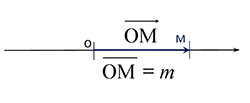

What do complex numbers really represent? How can we "picture" i² being equal to −1? A striking visual answer comes from interpreting multiplication geometrically. The icing on the cake is that the same model explains why "a negative times a negative makes a positive."


Articles recommended for you.

Studying isometries of the plane—reflections, translations, rotations, and so on—can sometimes be dizzying. What happens to a point or figure when several transformations are applied in succession? Complex numbers provide a representation that is as elegant as it is illuminating.

Once we accept the existence of a number i such that i² = −1, do we risk losing touch with physical reality? Quite the opposite: a profound and fruitful correspondence emerges, allowing questions of pure geometry to be solved through simple algebraic manipulations.

The set of complex numbers gained acceptance—with difficulty—when it became necessary to look beyond the real numbers for all the solutions of a quadratic equation. What no one had anticipated was its richness and the links it would forge with mathematics as a whole. Early discoveries.

René Descartes dreamed of turning a problem in pure geometry into an algebraic one. It took more than a century to realize that dream! Complex numbers opened up a new way to explore geometric figures and constructions.
Discussion
Sign in to post a comment and talk with other readers.
No comments yet. Be the first to respond.