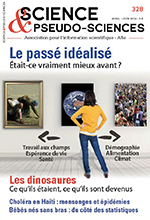
Cases of isolated transverse upper limb agenesis, dubbed "babies born without arms" in the press, have received considerable media attention in recent months. The reason: seven cases involving children born between 2009 and 2014 were reported in Ain. In the latest issue of Science et pseudo-sciences, epidemiologist and biostatistician Catherine Hill reviews the various statistical analysis methods used to determine what makes clusters of cases across time and space significant. These procedures are used to identify external causes of certain epidemiological phenomena.
By comparing observed case numbers with expected numbers, researchers can determine whether the number of cases at a given time and place is abnormally high. Once that has been established, the causes must still be investigated… As for isolated transverse agenesis, which has also been observed in Morbihan and Loire-Atlantique, no cause has yet been identified.