Arriving in 1963 in terminale scientifique (the science-track final year of secondary school, the famous "math élém"), they made a timid entrance there, defined as pairs of real numbers onto which an artificial form of multiplication had been grafted, (a, b) × (c, d) = (ac – bd, ad + bc), which seemed to students to come from another planet. In the 1966 curricula, they gained a better standing, with their algebraic structure as a "field" clearly stated, along with their host of applications: trigonometric form, De Moivre's formula, nth roots, and the solving of second-degree equations with real or complex coefficients.
Then, in the 1970s, came "new math": as early as 1971 it introduced into the school curricula a new presentation of complex numbers, this time defined as matrices of direct plane similarities, since the curriculum does indeed speak of "the field of matrices " and turns it into a vector space over , on which the triangle inequality was even officially renamed the "Minkowski inequality". The 1982 terminale C curricula seemed, to students at least, more realistic, dropping matrix algebra and vector space but introducing the exponential form of complex numbers as well as the linearization of polynomials.
Dropped in 1987, reinstated in 1994 in the terminale curricula—by then renamed S—and dropped again in the 2002 curricula, the topic of polynomial linearization seems highly unstable. Complex numbers, in any case, are still today part of the compulsory terminale S curriculum, but, seen "essentially as constituting a new set of numbers with its own operations", they are meant to be understood "with a view to a more thorough treatment in the course of further study".
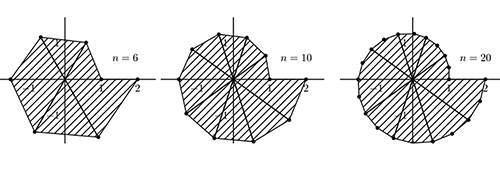
Today, the topic of complex numbers still holds a prominent place in bac S problem sets, sometimes giving rise to rather aesthetic interpretations, such as the compass-and-straightedge construction of a regular pentagon (Pondicherry, 2016), or the depiction of an infinite broken line of finite length (Centres étrangers, 2014), or, prettier still, the modeling of a nautilus shell (Centres étrangers, 2016).