Exploring databases
------------------------------------
Finding reliable databases is not always easy. Economists often face a mass of information whose relevance is not always established. There are, however, several official websites providing French and European data. Official statistics for France are available on the website of the Institut national de la statistique et des études économiques (Insee, www.insee.fr/fr/accueil ). More detailed data on social affairs are available at travail-emploi.gouv.fr. For useful data on Europe, the Eurostat website has a French-language version ( ec.europa.eu/eurostat/portal ) and interactive tabs that make the data easier to read and interpret. Finally, an overview of OECD (Organisation for Economic Co-operation and Development) statistics is also available in French. All that remains—something of an understatement—is to interpret the data…
-
Different types of economic indicators
------------------------------------------
Economic indicators fall into three categories according to their time frame. Time series tracking changes in economic data are available in many areas: unemployment rates, interest rates and gross domestic product (see our first feature). Because they are based on confirmed data, these indicators measure past economic activity and allow it to be modelled. They are known as lagging economic indicators. Curiously, their publication has a direct impact on markets, even though there is no reason to assume that past trends will continue…
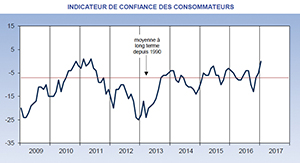
Measurements are also taken continuously to capture economic activity as it happens. These coincident economic indicators are intended to gauge current economic activity. Finally, there are leading economic indicators, which are much harder to assess and are intended to anticipate changes in trends on the basis of lagging and coincident indicators. For example, it may be assumed that a growth trend and a high current consumer-confidence reading suggest higher consumption in the future. This trend will later be confirmed or disproved when the corresponding lagging indicator is modelled.
-
Some key indicators
-----------------------------------
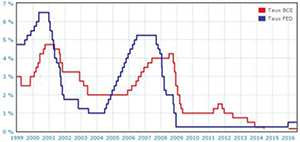
Key interest rates are set by central banks such as the ECB (European Central Bank) and the Fed (Federal Reserve System in the United States). These are the rates at which central banks provide short-term loans to commercial banks. They do not necessarily reflect the real situation—they are currently artificially negative—but have an enormous impact on the economies of the countries concerned by influencing lending, imports and exports, and the level of inflation. They are published once a month.
The consumer price index (CPI) measures a country's inflation level by estimating changes in the retail prices of a standard basket of consumer goods relative to changes in wages. It assesses the relative change, between two successive points in time, in the prices of the products consumed by households on average.
The unemployment rate measures the percentage of the labor force who are unemployed and seeking work, relative to the total labor force. How it is defined has a significant effect on the data collected, as was recently seen in Belgium, where tens of thousands of jobseekers were excluded from unemployment statistics for various, disputed reasons, producing a substantial but artificial fall in the rate.