



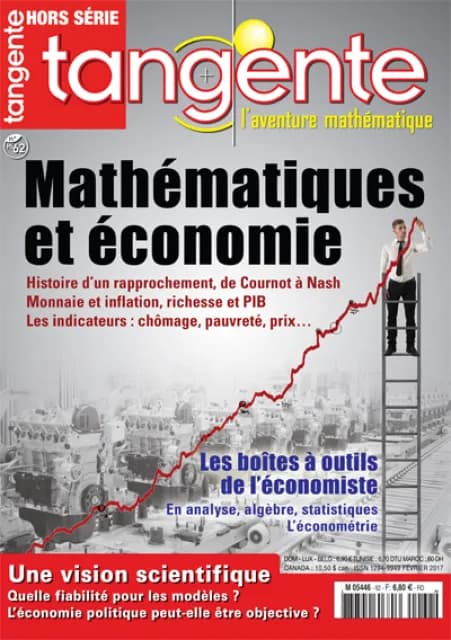
Mathematics and economics
This issue is not fully translated into English yet; only translated content is shown.
Read the French versionAll folders in this issue

The major concepts of economics
We only talk about it, without necessarily knowing what it covers! Economics studies the production and exchange of consumer goods, at the base of most human activities. Barter in early societies developed into a complex system. It is important to understand the essential concepts, constantly mentioned but whose meaning is often unknown: money (increasingly virtual), inflation, GDP, and the main indicators that structure and condition the health of states and citizens.

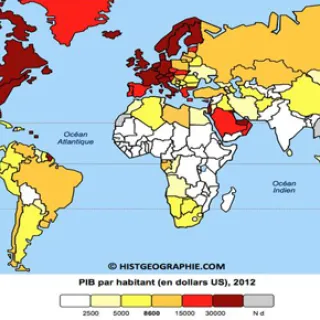

Encounters between economics and mathematics
The mathematical models used in economics are recent, but their role has become predominant today (even if our decision-makers don't always make the effort to try to tame them). Applications and illustrations of the main mathematical domains interfere daily with decision and management systems, making them increasingly efficient. Using linear algebra or differential and integral calculus, the economist was forced to become a major user of mathematics. Using concrete examples, readers of Tangente are invited to understand these concepts, not always known to the general public.



A fundamentally statistical science
The world of economics is fluctuating, moving, sometimes unpredictable. It must constantly adapt to the evolution of our societies and the behavior of citizens. There is therefore nothing surprising that statistical methods, probabilistic models and tools of stochastic analysis are increasingly present in it. The data are confronted with reality, the materiality of facts, measured through surveys, field experiments, tests… Thus, in the production and management plans of companies, the structured study of past results leads to the elaborate construction of forecasting models minimizing risks and optimizing the sustainability of activities.

All articles in this issue
Emergence in economics
Economics, too, has emergent properties! They create order despite apparent disorder, as if through "self-organization."

Unemployment and energy supply: problems solved!
Discover mathematician Hermann Laurent's proposal for putting unemployed people to work.
French economy boosted by… mathematics
Mathematics has a major socioeconomic impact in France. AMIES proves it!

The saga of economic indicators 1
What do these economic indicators we hear so much about in the media actually mean?

The Nobel Prize saga, part 1
Contrary to popular belief, there is no Nobel Prize in Economics! Discover the truth about this prize...

The Nobel Prize saga, part 4
The Nobel Prize in Economic Sciences saga concludes with the economists honored for their research in finance.
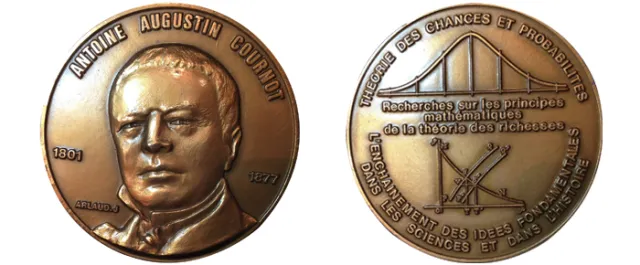
Antoine Cournot: from mathematics to economics
Economics did not always have much to do with mathematics, and for a long time its reasoning was verbal, until the arrival of thinkers such as Antoine Cournot, who brought rationality into the field in the 19th century.

Economics in question
What is economics? Can it be regarded as a science? What role do mathematical models play in its analysis and development? Can they counterbalance decisions based exclusively on a dogmatic approach?