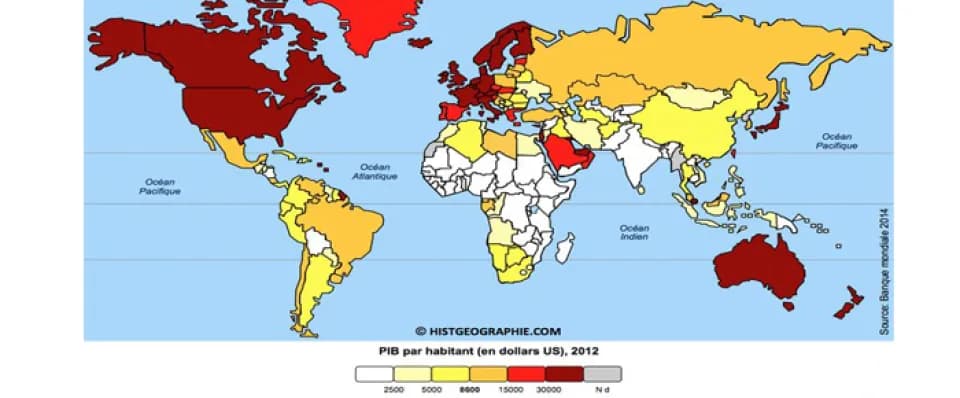
What we call GDP, or gross domestic product, is an indicator of an economy's volume of production. As a first approximation, it is defined as the sum of the monetary values of all goods and services for final consumption produced within a given geographical area over a specified period.
In mathematical terms, we write
where pi and qi represent, respectively, the selling prices and quantities produced of final consumption goods of type i, that is, goods intended for purchase by a private consumer (bread, a television for private use, etc.). Goods purchased for business use, known as intermediate goods, are not counted (a delivery van, a computer for business use, etc.).
Why include only goods for final consumption? A simple example provides the answer. Consider the manufacture of a table. A carpenter buys planks, which are produced and sold by a sawmill. He turns these planks into tables and sells them. The carpenter's sale price will obviously include both the purchase price of the planks and his profit margin. The price of the planks sold by the sawmill is therefore included in the sale price of the finished tables.