2000: the ENS student revolt
-------------------------------

An open letter from economics students, launched by students at the École normale supérieure on rue d'Ulm and published in Le Monde on 17 June 2000, criticized the excessive prominence of mathematics in economics teaching. It read in part: "The practical use of mathematics may be necessary, but reliance on mathematical formalism, when it ceases to be a tool and becomes an end in itself, produces a genuine disconnect from the real world." The students objected that too many exercises involved merely manipulating models with no direct link to reality, encouraging a kind of "single-track thinking." Philippe Mongin, a research director at the CNRS, challenged that charge and argued that "mathematics is a tool of analysis and exposition, not a vehicle for any particular agenda".
Mongin was right, of course, but the students were also right to argue that many models served only as exercises—exercises that made selection easier, smuggled in neoclassical ideas, and drew students away from contemporary economic debates.
The students continued their campaign through the Mouvement Autisme-économie. The dispute spread beyond France, drawing support from various quarters, including the English-speaking world. Too often reduced to the question "for or against maths in economics?", the movement sought to restore a mathematical model to its proper role: it should be grounded in the facts.
-
1960: the Cambridge capital controversy
-------------------------------------

In 1960, a mathematical controversy pitted economists Joan Robinson and Pierre Sraffa of the University of Cambridge in Britain against Paul Samuelson and Robert Solow of MIT in Cambridge, Massachusetts.
In neoclassical economics, founded in the late 19th century by Carl Menger, William Stanley Jevons and Léon Walras, the valuation of capital—that is, the factors of production—is fundamental. It is especially important for determining marginal product, which is closely tied to wages.
The British economists opened the controversy by pointing out that calculating the total amount of capital meant adding together things with nothing in common, such as ten-year-old trucks and brand-new computers. The Boston economists replied that one need only add up the monetary values of the factors of production.
The dispute did not subside until 1962, when both sides acknowledged that capital valuation was useful but necessarily imprecise, and that investment was a key driver of growth…
-
Keynes vs Hayek
-----------------
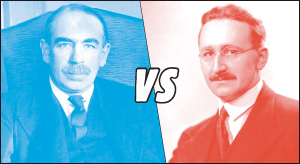
For more than three-quarters of a century, the economists John Maynard Keynes (1883–1946) and Friedrich Hayek (1899–1992), along with their followers, have clashed over diametrically opposed views of economic behavior and policy.
Hayek championed unfettered free-market economics; he regarded all state intervention as harmful, including welfare provision. His theories rest on mathematical models in which economic agents have perfect knowledge of the market and act solely on rational grounds. They were especially influential in the English-speaking world in the 1980s and 1990s.
Keynes, who was trained as a mathematician, took the opposite view: he believed that consumers sometimes behave emotionally or out of habit, rather than rationally. State intervention, he argued, is therefore necessary to maintain social equilibrium. His ideas shaped the postwar era and helped bring about France's postwar boom, the Trente Glorieuses.
Keynes likened econometrics to alchemy, and Hayek likened mathematical economics to magic…