In January 2025, the University of Cambridge announced that it had recruited Hannah Fry, a mathematician who had become well known to the general public through her books and numerous appearances popularizing mathematics on television and social media. Fry thus added her name to those of Isaac Newton, Augustus de Morgan, Arthur Cayley, Bertrand Russell, Godfrey Harold Hardy and, more recently, Michael Atiyah. One quickly notices how few women appear on this list of Cambridge figures distinguished in mathematics: the only notable exception is Mary Cartwright (1900–1998), a pioneer of chaos theory. This gender imbalance speaks volumes about the deeply troubled history of women at the university.
The founding of Girton and Newnham
---------------------------------
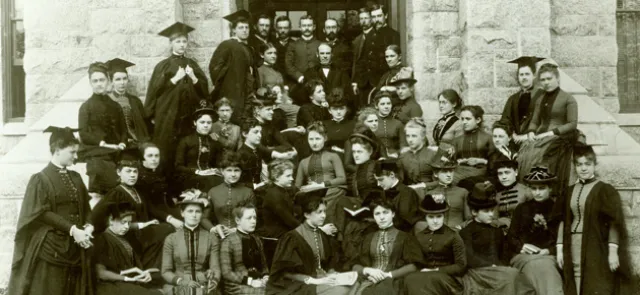
Let's sketch the broad outlines of the story. The university was founded in the 13th century, with a structure inherited from the medieval world and organized around some fifteen colleges. Although the university required the colleges to follow regulated procedures for teaching and examinations, each admitted students according to its own criteria. Until the 19th century, however, they all agreed on one principle: only young Anglican men were to be admitted. As society changed with the Industrial Revolution, admission requirements gradually evolved, but the rules remained firm on admitting men alone. This discrimination prompted artists and intellectuals—most of them, in fact, women—to consider how women might gain access to higher education in general and Cambridge in particular. Thus, in 1869, a new institution affiliated with the university but reserved exclusively for women was founded: Girton College. Girton's first intake—then housed more than 25 km from the university center—comprised five students, one of whom wished to study mathematics: Sarah Woodhead (1851–1912).
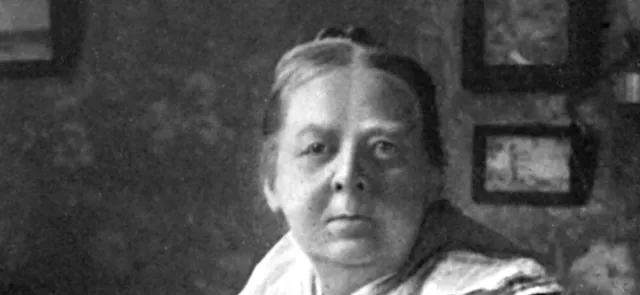
She was 18 when she arrived at Cambridge and, unlike other young women of her day, had received a proper secondary education; she was a Quaker\ and, in that faith, schools admitted girls as well as boys. At Girton, she spent four years following a course similar to that taken by men at the other colleges, but at the end of those years she was permitted neither to sit the examinations that completed the course—the extremely demanding "Mathematical Tripos"—nor to receive a degree. Since the university and the other colleges* remained firm on this point, Girton's administrators found a way around the rules: Woodhead would answer the same papers as her male counterparts, but unofficially and in a separate room, after which the examiners would be asked to mark this additional script simply so that Girton could certify that she had indeed met the undergraduate requirements. Thus, in 1873, Woodhead became the first woman to sit the Mathematical Tripos. She left the university without a degree, but with a modest reputation and genuine skills, even if they went unrecognized; she later founded a girls' secondary school so that others could follow in her footsteps into higher education and mathematics.
(* The Quakers, or Religious Society of Friends, are a Christian movement founded in England in the 17th century and now numbering 350,000 people.)