Mathematicians exist, and every middle-school and high-school student has come across them. Even though Thales, Pythagoras, Newton, Euler, Chasles and the like often remain abstract names, referring only to theorems or formulas, their names appear throughout the standard mathematics curriculum. And women mathematicians? If you were asked to name some, you might, to your own bewilderment, struggle to come up with more than three.
Forgotten but not absent
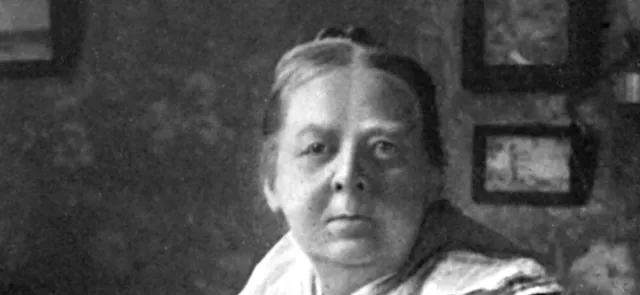
If we consult the 1980 edition of the Dictionary of Scientific Biography, which runs to no fewer than sixteen volumes and is a recognized reference work in the history of science, we find, among mathematicians who died before 1972, only six women's names out of 966 entries. These are Hypatia (370?-415), Maria Gaetana Agnesi (1718-1749), Sophie Germain (1776-1831), Mary Somerville (1780-1872), Sofia Kovalevskaya (1850-1891), and Emmy Noether (1882-1935). A few new names appeared in the 2007 edition: Olga Oleinik (1925-2001), Olga Ladyzhenskaya (1922-2004), Julia Robinson (1919-1985), Ada Byron (1815-1852), Tatiana Ehrenfest (1876-1964), and Grace Hopper (1906-1992), out of around 160 new entries. These women mathematicians are among the most famous, but many others made significant contributions to the development of mathematics.
Exploring other sources — for example the very well-known Mac Tutor History of Mathematics Archive site at the University of St Andrews in Scotland, which is updated very regularly — you would have found about a hundred women mathematicians among more than 3,500 entries. Fortunately, things are changing, thanks to the efforts of associations of women scientists and mathematicians: the number of listed women mathematicians has grown considerably, and a "female mathematicians" section has been created. To these English-language references we would add, among other works, the Dictionnaire universel des créatrices, published by Éditions des femmes, where women mathematicians find their "small" place. Until the end of the 19th century, few women left their mark on mathematics. If history has thus given women mathematicians only a tiny place, they are, fortunately, numerous today, throughout the world, despite various specific obstacles that persist, and difficulties in being recognized.
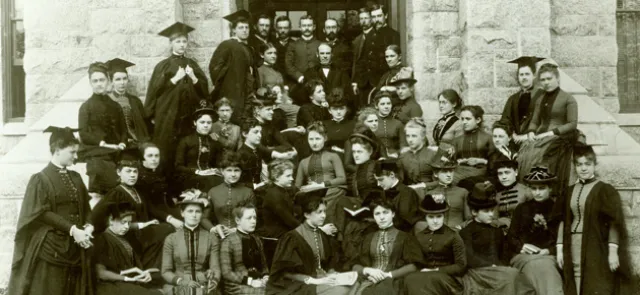
Why, then, this near-absence of women in the field of mathematics until the end of the 19th century? The first explanation that comes to mind is obviously that girls have had access to higher education for only about a century. And if we take the French example, they were only able to receive secondary education starting in 1880. What's more, their curricula, particularly in mathematics, were much lighter than those of boys. It was not until 1924 that the two curricula were unified.