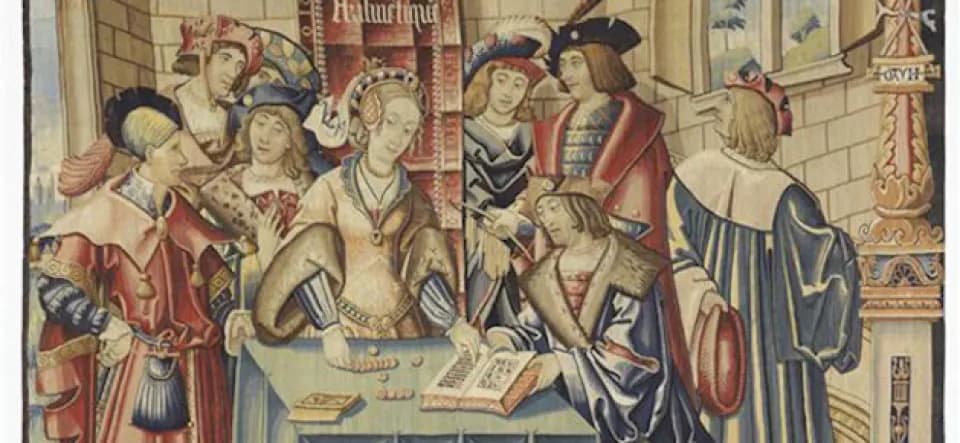
From the end of Antiquity, and throughout the Middle Ages, the so-called liberal arts formed the foundation of knowledge: these seven disciplines fell into two groups, the trivium, which brought together the three arts of language (grammar, rhetoric and dialectic), and the quadrivium, encompassing the four arts regarded as those of number (geometry, arithmetic, music and astronomy). The first Christian author to mention them was Saint Augustine (354–430). In his De Ordine (II, 12), he defines seven disciplines that comprise almost all the knowledge man could acquire outside of revelation. Above these seven arts stands philosophy, their mother. From a Christian perspective, following Boethius, the liberal arts were regarded as a preparation for theology, that is, for the study of Holy Scripture.
Female representations
The liberal arts had been a subject for representation as early as the 9th century, but it was from the 12th century onward that this theme became a genuine iconographic tradition. Throughout this period and beyond, these arts were represented and personified across various media (sculpture, stained glass, illumination, tapestry, fresco) by as many female figures.
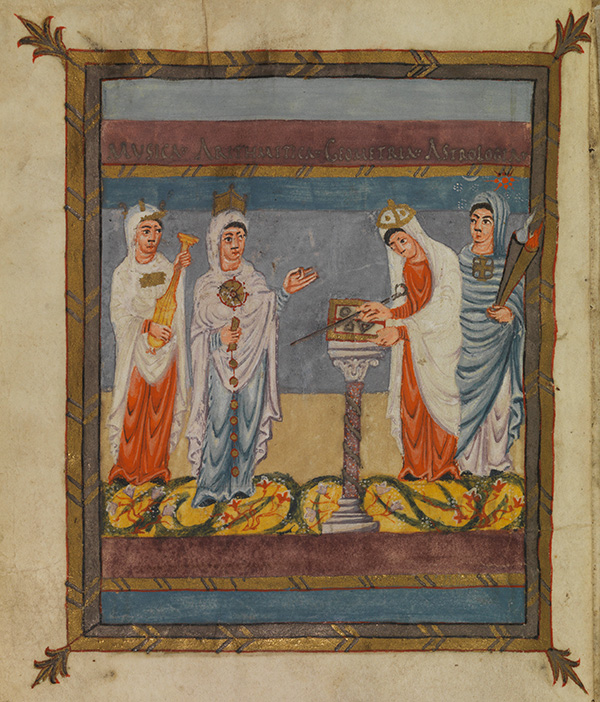
In a manuscript of Boethius's De institutione arithmetica, dated to around 845, music, arithmetic, astronomy and geometry are depicted as ladies of the period.