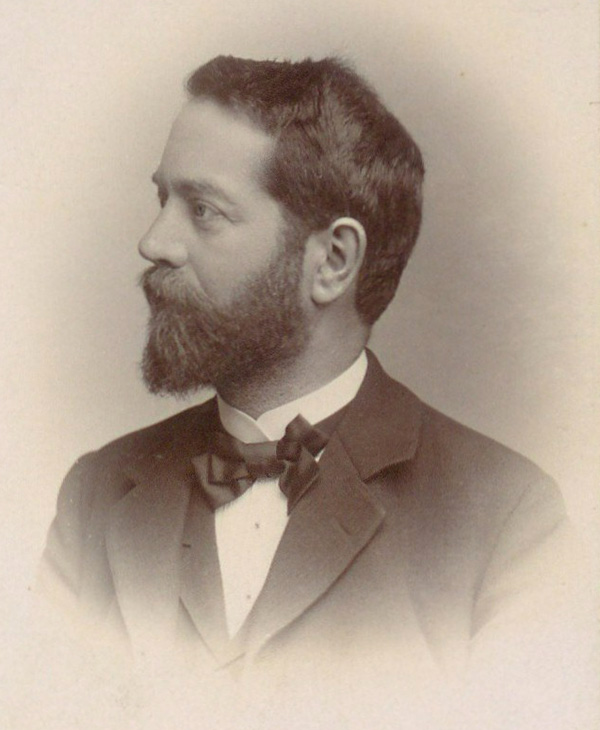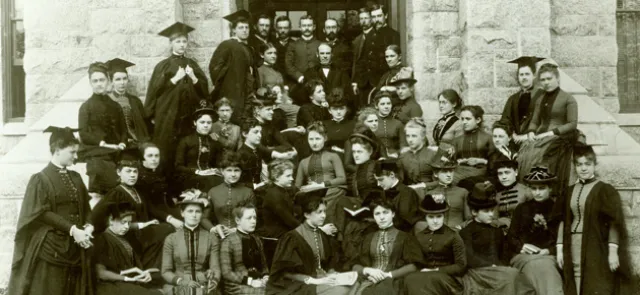

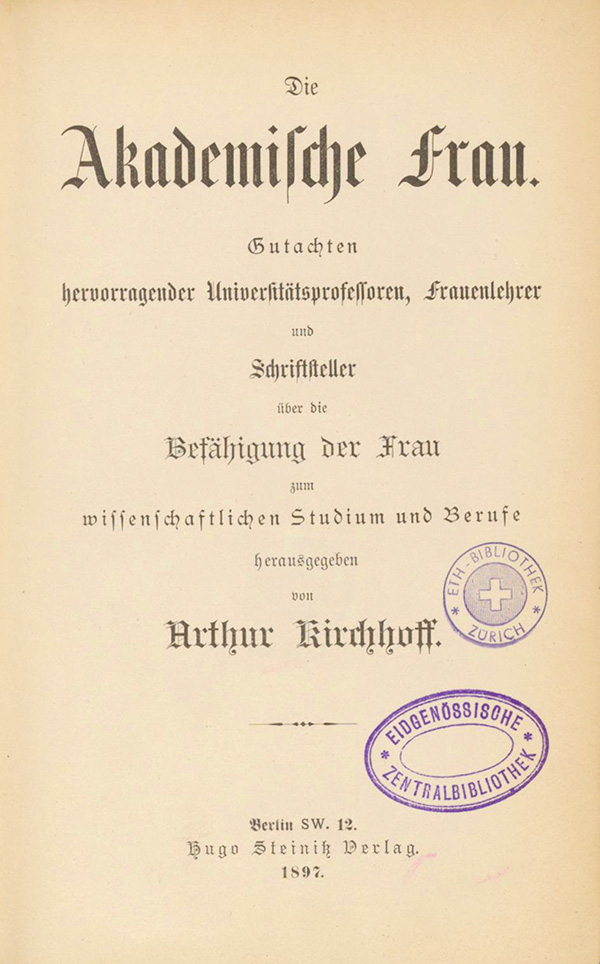
In 1897, a multi-author volume titled Die Akademische Frau ("Women and the University") was published, in which numerous scholars surveyed every field, from philology to medicine and from economics to mathematics. Felix Klein (1849–1925) contributed a powerful essay, substantial excerpts from which follow.
"I am all the more willing to answer this question because the view that still prevails in Germany—that mathematical studies, at least, should be virtually inaccessible to women—probably constitutes a major obstacle to all efforts to develop higher education for women. I am not referring here to exceptional cases, which as such prove very little, but to our experience of the average student at Göttingen.
Nor do I wish to dwell on the matter here, but merely to mention that, this semester, for example, no fewer than six women have attended our advanced mathematics lectures and classes, consistently proving themselves in every respect the equals of their male counterparts.
Given the circumstances, for the time being they are all foreigners: two American women, one Englishwoman and three Russian women. […]
I declare myself in favor of admitting women to university study. Should we men not finally recognize that we have no right whatsoever to decide continually, on our own authority, what women should be allowed to do? What gives us that right? It comes from more brutal times; is it right that we should still cling to it today?
How have we come to regard them as less capable? We force them to make do with an education inferior to the one we receive; naturally, they then know less, but that does not justify the conclusion that they are less able. […]
As far as mathematics is concerned, there have indeed been women mathematicians engaged in research and teaching. In recent times, Sofia Kovalevskaya, who held a professorship in Stockholm, is well known; and at the beginning of the century there was Sophie Germain, who corresponded with Gauss for many years without his knowing that he was corresponding with a woman. […]
From the perspective of my own discipline, mathematics, no serious grounds can be advanced against women pursuing university studies. The strongest argument in their favor is that, in both ancient and modern times, women have made truly remarkable contributions to mathematics.
Beyond these exceptional cases, however, the experience of the universities of Göttingen and Zurich proves that women are capable of pursuing mathematics successfully; the situation in England likewise bears this out. In England, many women work in mathematics and even publish on the subject; in particular, many of them help solve problems set by journals (such as the Educational Times, for example), with the solutions published at a later date.
I therefore have not the slightest doubt that women are capable of producing fruitful results in my discipline. Admittedly, it is still difficult at present for women in Germany to acquire the necessary background to attend university courses successfully, because no mathematics at all is taught in our girls' schools. The next objective should therefore be to give women the opportunity to acquire the knowledge that a high school requires of its graduates. I am firmly convinced that this is entirely within the capabilities of the average young woman."