Paul Samuelson, from thermodynamics to economics
--------------------------------------------------
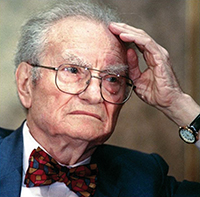
Paul Anthony Samuelson (1915–2009).
In 1970, the Sveriges Riksbank Prize was awarded to Paul Samuelson, who was one of the pioneers of applying differential and integral calculus to economics. His work drew heavily (and openly) on that of Josiah Willard Gibbs (1839–1903), one of the founders of vector analysis and chemical thermodynamics. Samuelson also introduced probability theory into solving economic problems, notably by applying the method of comparative statics to economics. Finally, he was the author of works that have served (and still serve) as essential references for those wishing to be introduced to economics. This is true of his Foundations of Economic Analysis, published in 1947. This man of genius could also prove an outstanding teacher.
-
Gérard Debreu and the topology of economics
-------------------------------------------
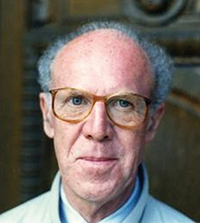

Gérard Debreu (1921–2004). ****Kenneth Joseph Arrow (born 1921)****
Gérard Debreu, the French mathematician and economist, was honored in 1983. He is the author of a famous theory of value, which drew on sophisticated and recent mathematical results. His major work, Existence of an Equilibrium for a Competitive Economy, was written in 1954 in collaboration with Kenneth Arrow. Arrow, born in 1921 and also a Nobel laureate in 1972, devised the famous impossibility theorem that bears his name, generalizing Condorcet's paradox and highlighting the limits of the democratic system.
Debreu's results also draw on topology. He proves the existence of a continuous utility function for a consumer under fairly broad assumptions, a result that has become one of the foundations of current economic theory. Gérard Debreu was the first Frenchman to receive the famous distinction.
-
Jean Tirole, a champion of interdisciplinarity
---------------------------------------------------
**
**
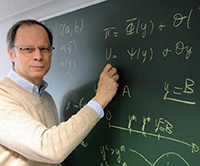
**Jean Tirole (born 1953).**
The Frenchman Jean Tirole, who currently works in Toulouse, was honored in 2014. This engineer of the Corps des Ponts et Chaussées also holds a doctorate in decision mathematics from the University of Paris-Dauphine (1978). His work skillfully blends economic models and psychology, bringing together game theory and information theory, and combining these elements for a better understanding of financial crises. His positions are principled and courageous. Thus, during the 2008 subprime crisis, he declared, during a hearing before a National Assembly committee on banking regulation: "We must not throw the baby out with the bathwater: there can be no question of going back on securitization or on the existence of derivative products, for these innovations have positive effects. What will be needed, however, are the technical measures necessary to ensure that abuses cannot happen again" (information report on the international financial crisis, National Assembly, Paris, 5 November 2008).
Jean Tirole is the author of about ten reference works, including The Theory of Corporate Finance, which analyzes corporate finance from the perspective of maximizing the firm's value for its shareholders over a long horizon. Several of his books have been translated into French (!), such as Théorie de l'organisation industrielle or Économie du bien commun, which is a superb example of successful popularization.