An 8 cm object that held two millennia of silence
Imagine a blackened papyrus scroll, compressed to the size of a champagne cork, that no one has been able to read since Vesuvius buried it in 79 AD. In the 1980s, specialists attempted — unsuccessfully — to partially open it. Too fragile. Too charred. This scroll, catalogued as PHerc. 1667, now measures about 8 cm in height and 2 cm in diameter, according to the University of Kentucky press release. And yet, on June 25, 2026, papyrologists announced that it had finally given up its secrets: nearly 1.5 meters of continuous Greek text, spread across twenty columns.
No one opened it. No one touched the papyrus. What changed was the mathematics.
Seeing without touching: an inverse problem in three dimensions
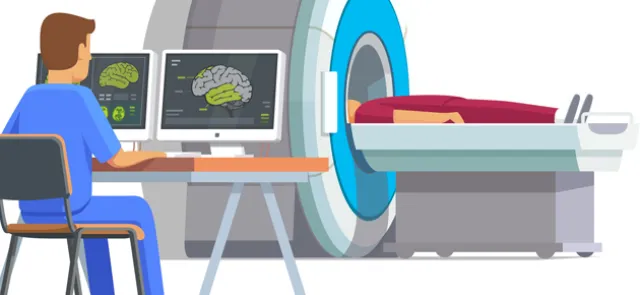
To understand what happened, let's set artificial intelligence aside for a moment — it only comes in at the very end. The real feat at the outset is a mathematical reconstruction problem that physicists call tomography. The principle: bombard an object with X-rays from hundreds of different angles, measure what emerges on the other side, and mathematically reconstruct the interior from all these projections.
Each projection is, strictly speaking, an integral — a sum of all the densities encountered along a ray. On its own, this figure says nothing. But accumulate thousands of these sums taken at different angles, and you can invert the process. This is what mathematicians call the inversion of the Radon transform, a result formalized in the early 20th century, whose foundations are laid out in the classic reference on tomographic imaging: linking each measured projection to a slice of the object's Fourier transform, then reconstructing the entire volume. The CT scan you may have had done one day relies on exactly this mechanism.
Except that for a charred papyrus, classical X-ray absorption is not enough. Ancient ink and burnt papyrus respond to X-rays in an almost identical way — the contrast is nearly zero. This is where phase contrast comes in. An X-ray is not only absorbed by matter: it is also slightly deflected, and its phase is altered. Exploiting these tiny phase shifts reveals interfaces and density variations invisible under classical absorption. The associated mathematical method — known as phase retrieval, a reference formulation of which was published in the Journal of Microscopy by Paganin and colleagues — makes it possible to extract this information from a single, slightly defocused image. This is the protocol that was implemented at the Grenoblesur Synchrotron, one of the most powerful synchrotrons in the world.
A single scroll can generate up to 300 terabytes of data. Twenty to twenty-four hours of scanning.
Unrolling without unrolling: the geometry of crumpling
We now have a 3D volume. But a scroll is not a cube — it is a surface rolled up on itself, compressed, and deformed by two millennia of heat and pressure. To read the text, this surface must be found within the volume, then digitally "unrolled" into a readable plane. This is a surface parametrization problem.
The central idea, formalized in a foundational paper by Brent Seales and colleagues applied to a charred scroll from En-Gedi, rests on a quasi-isometric assumption: a sheet that was flat before being rolled up can be digitally flattened, provided its internal distances are preserved. In practice, the surface is modeled as a mesh, and "relaxed" toward a plane using a mass-spring physical model. The result is a 2D image of the page, reconstructed without ever touching the object.
For PHerc. 1667, this pipeline yielded twenty columns of Greek text. The preprint by Giorgio Angelotti, Stephen Parsons, Federica Nicolardi, Youssef Nader, Brent Seales, and twenty-two other authors, posted on arXiv, presents this scroll as the first Herculaneum papyrus to be fully unrolled digitally and read for extended scholarly study — without physical opening.
AI enters the picture — but in its rightful place
It is only here, once the unrolled surface has been obtained, that machine learning comes into play. And its role is more subtle than is generally imagined.
The neural network does not "read" Greek words directly. It first produces an ink probability map: for each voxel (the 3D equivalent of a pixel) in the volume, it estimates the probability that ink is present. The architecture used in the Vesuvius Challenge's work, described in a paper presented at ICCV 2023, combines classical 3D convolutions with volumetric fast Fourier convolution — which allows the network to capture both local and non-local patterns within the volume. The model is trained on opened fragments where the location of the ink is known through infrared imaging, then applied to intact scrolls.
It is the combination of synchrotron imaging, phase contrast, geometric unrolling, and probabilistic detection that makes this possible. Each step is a distinct mathematical problem.
What the scrolls say — and what they might still be hiding
The text of PHerc. 1667 is a philosophical treatise on ethics set against a Stoic background. It contains Greek notions such as ὁρμή (impulse) and φρόνησις (practical wisdom), as well as a mention of Aristocreon, nephew and disciple of Chrysippus. The suggested dating points to the 2nd or 3rd century BC. The same campaign made it possible to identify PHerc. 139 as On the Gods, Book 8 by Philodemus, and to recover more than 70 columns in PHerc. 172, according to the University of Kentucky press release.
"This scroll was deemed completely illegible when it was partially opened in the 1980s", recalls Federica Nicolardi, a papyrologist at the Università degli Studi di Napoli Federico II. Brent Seales, co-founder of Vesuvius Challenge and professor of computer science at the University of Kentucky, sees this announcement as a turning point: "From now on, we're going to be talking more about the texts than about the technology."
More than 600 Herculaneum scrolls reportedly remain unopened. Only about 10% are said to have been scanned at this stage. Hopes of recovering lost mathematical treatises are no longer science fiction. They are, for the first time, an optimization problem.