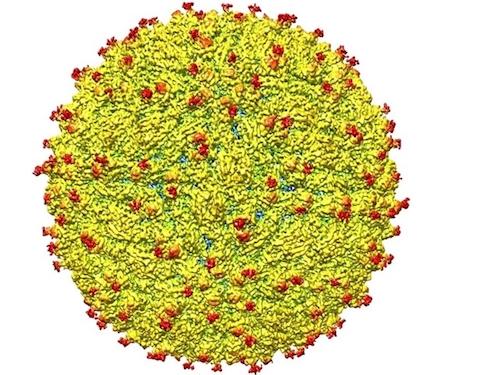
This colorful shape, with an icosahedron structure (a polyhedron with twenty faces, each an equilateral triangle), with a few bulges, is anything but harmless. It is a particle of the Zika virus, and it is highly dangerous for the brains of newborns. Two researchers at Purdue University (Indiana), Michael Rossmann and Richard Kuhn, made it possible to visualize it under a cryo-electron microscope, after first rapidly freezing the samples in liquid ethane before observation. In the resulting image, the colors indicate the distance from the center of the polyhedron — in a sense, its radius: above 130 Å (1 angstrom = 10–10 metre) in blue, between 131 and 150 Å in blue-green, between 151 and 190 Å in green, between 191 and 230 Å in yellow, and above 231 Å in red. It contains 180 copies of two different proteins, enclosing their RNA genome and coated with a lipid membrane.
We have already come across other viruses of the same shape, such as those causing dengue and yellow fever, and a thorough knowledge of their shape matters: it helps researchers fine-tune antiviral treatments and vaccines. Yet another field where mathematics is set to help medicine.