Counting the regular polyhedra
---------------------------------
How many regular polyhedra are possible? Euler's formula makes this question very easy to answer!
A polyhedron is regular if all its faces are regular polygons (with p sides) and the same number q of faces meet at each vertex. Each face contributes p sides, which pair up to form A = p (F / 2) edges. At each vertex, q edges meet, so A = q (S / 2); remember that every edge has two endpoints. Substituting the expressions for S and F in terms of A into Euler's formula F + S = A + 2 gives 2A / p + 2A / q = A + 2. Factoring and putting everything over a common denominator yields A (2p + 2q – pq) / pq = 2. Adding and subtracting 4 inside the parentheses gives A (4 – (p – 2)(q – 2)) / pq = 2.
Since A, p and q are strictly positive integers, such a relation is possible only if (p – 2)(q – 2) < 4. Moreover, since p ≥ 3 and q ≥ 3, the only possible cases are:
| p | q | Polyhedron | A | S | F |
|---|---|---|---|---|---|
| 3 | 3 | Tetrahedron | 6 | 4 | 4 |
| 3 | 4 | Octahedron | 12 | 6 | 8 |
| 3 | 5 | Icosahedron | 30 | 12 | 20 |
| 4 | 3 | Cube | 12 | 8 | 6 |
| 5 | 3 | Dodecahedron | 30 | 20 | 12 |
Arithmetic thus gives us five possible regular polyhedra. Geometric constraints do not reduce this set: there are indeed five such solids, called Platonic solids.
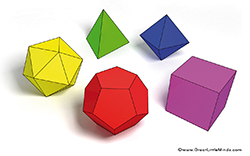
The cube (in purple), the dodecahedron (in red), the icosahedron (in yellow),
the tetrahedron (in green) and the octahedron (in blue).
The Euler–Poincaré–Schläfli formula
-------------------------------------
Henri Poincaré and Ludwig Schläfli succeeded in generalizing Euler's formula, which holds in three-dimensional space, to every d-polytope—that is, every bounded convex polyhedron of dimension d (meaning an intersection of finitely many closed half-spaces in d-dimensional space). For a d-polytope P, this generalization gives a relation between the numbers of its k-faces (for 0 ≤ k ≤ d – 1). This generalization yields the following elegant formula, in which *fk (P) denotes the number of k*-faces of P:
When d = 2, P is simply a convex polygon; its 0-faces are its vertices, while its 1-faces are its sides. The formula, which becomes f0 (P) = f1 (P), states that P has as many vertices as sides.
For d = 3, we recover Euler's formula: S = f0(P), A = f1 (P) and F = f2 (P).
For d = 4, the number of vertices plus the number of planar faces equals the number of edges plus the number of three-dimensional faces. This result can be verified for the six types of regular 4-polytopes (the polychora), the analogues of regular polygons in dimension 2 and Platonic solids in dimension 3. Each polychore is related to a regular polyhedron—except the 24-cell—and takes its name from the corresponding polyhedron with the prefix "hyper-" added.
| Polychore | Number of vertices (k = 0) | Number of edges (k = 1) | Number of 2-faces (k = 2) | Number of 3-faces (k = 3) |
|---|---|---|---|---|
| Hypertetrahedron | 5 | 10 | 10 (triangles) | 5 (tetrahedra) |
| Hypercube | 16 | 32 | 24 (squares) | 8 (cubes) |
| Hyperoctahedron | 8 | 24 | 32 (triangles) | 16 (tetrahedra) |
| 24-cell | 24 | 96 | 96 (triangles) | 24 (octahedra) |
| Hyperdodecahedron | 600 | 1,200 | 720 (pentagons) | 120 (dodecahedra) |
| Hypericosahedron | 120 | 720 | 1,200 (triangles) | 600 (tetrahedra) |
Euler's hyperplane
-------------------
The Euler–Poincaré–Schläfli formula has an elegant geometric interpretation using the vector f (P) = ( f0 (P), f1 (P), f2 (P)… *fd*–1(P)), called the f-vector of P, and the Euler hyperplane H defined by the equation
The f-vectors of all d-polytopes lie in H, but they do not all belong to a single subspace of dimension less than d – 1.
Thus, in three-dimensional space (where x0 = x, x1 = y and x2 = z), H is the plane with equation x – y + z = 2; all the f-vectors belong to this plane, but they are not all contained in a single line. In four-dimensional space (where the coordinates of points are often denoted by x, y, z and t), the f-vectors of all 4-polytopes belong to the three-dimensional subspace defined by the equation x + z = y + t, but do not lie in a single plane.