A life between mathematics and philosophy
-------------------------------------------
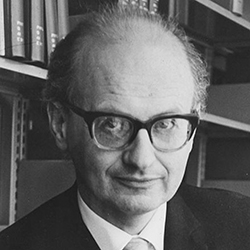
Imre Lipsitz was born in Budapest on November 5, 1922. In 1944, he adopted Lakatos, a name more common in Hungary (meaning "locksmith"). He studied mathematics, physics and philosophy at the University of Debrecen; he completed his education at Budapest's renowned Eötvös College, then pursued further study at the University of Moscow under Sofia Yanovskaïa (1896–1966), a specialist in the history, logic and philosophy of mathematics.
He first worked at the Institute of Mathematics of the Hungarian Academy of Sciences, where he devoted himself to measure theory and probability. In 1956, he left his country because of the political situation. He moved to England, where he worked with the philosopher Richard Bevan Braithwaite (1900–1990), a specialist in ethics and morality. He then wrote his doctoral thesis, Essays in the logic of mathematical discovery, which was further developed in 1963–1964 in the landmark work Proofs and Refutations.
In 1969, Lakatos succeeded Karl Popper (1902–1994) as head of the Department of Philosophy and Logic at the London School of Economics. On February 2, 1974, at the age of 51, he died following a heart attack.
The role of speculation and criticism
-------------------------------------------
In the introduction to his major work, Proofs and Refutations, an essay on the logic of mathematical discovery (Hermann, 1984), Lakatos explains that its purpose is "to address certain problems in the methodology of mathematics. […] Its modest aim is to examine in detail the claim that informal, quasi-empirical mathematics does not develop through a steady increase in the number of unquestionably established theorems, but through the continual improvement of conjectures by means of speculation and criticism, through the logic of proofs and refutations."
To carry out his project, Lakatos uses… Euler's formula.
-
A mathematical experiment in the classroom
--------------------------------------
Lakatos imagines a class exploring a relationship among the numbers of vertices (S), edges (A) and faces (F) of a polyhedron. After some trial and error, a dialogue unfolds between the teacher and the students as they discover that Euler's formula holds for all regular polyhedra. Some think the relation S + F = A + 2 holds for any polyhedron; others disagree and set out to refute the conjecture.
The teacher proposes to "prove" the conjecture in three stages. He explains what he means by a "proof": it is a "thought experiment […] that suggests breaking the original conjecture down into sub-conjectures or lemmas, perhaps thereby placing it within a fairly remote body of knowledge"—in this case, the theory of "crystals" or that of "rubber membranes".
The discussion leads to several criticisms of the "proof" based on counterexamples. These are either local (refuting a lemma without refuting the main conjecture) or global (refuting the main conjecture itself).
After recounting the reflections prompted by these counterexamples, Lakatos "returns to the problem of content", then "to concept formation"; he next examines "how criticism can transform mathematical truth into logical truth" and finally considers another "translation of the conjecture into the 'perfectly familiar' terms of linear algebra". Fiction and reality come together in this text through the fictional dialogue between a teacher and his students, and through the many, often historical, footnotes that form an integral part of the work.
The discussions about Euler's formula "vividly reconstruct this episode in the history of mathematics, in which discovery and invention appear in all their heuristic, epistemological and philosophical aspects".