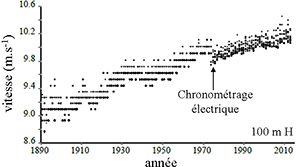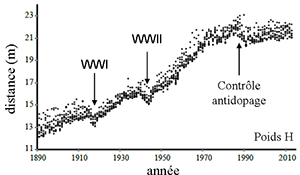

Citius, altius, fortius. The Olympic motto ("Faster, higher, stronger") sums up athletes' ambition to push the limits of human capabilities; for more than a century of competition, they have regularly broken records.


Articles recommended for you.

Combined events in athletics, such as the decathlon, require a way of comparing results across different disciplines. Scoring tables were therefore developed from statistical data and are regularly updated to reflect changes in human physical development.

Age is, of course, a predominant factor in athletic (and intellectual!) performance. This nonlinear decline can be modeled using an exponential model, which seems to hold at every physiological scale: cellular, skeletal, pulmonary…

Among the branches of mathematics applied to sport, statistics holds a prominent place. It is used to analyze large datasets—big data—to combat doping, and in media coverage of sport, typically for questions concerning the Olympic Games.

Although progress has been made in recent years, women remain underrepresented among those who use mathematics, from high school through to highly skilled scientific jobs. What lies behind this imbalance?
Discussion
Sign in to post a comment and talk with other readers.
No comments yet. Be the first to respond.