In mathematics, the term "identity" has a very precise meaning. It refers to an equality that holds true regardless of the values of its arguments, if it has any. Thus, cos2 x + sin2 x = 1 is one. In secondary education, algebraic identities mainly concern second-degree expressions. In higher education, we come across a few equalities involving low-degree polynomials, such as (a + b)(a2 – ab + b2) = a3 – b3. In other cases, we generally speak of formulas, as with the binomial formula or the famous trigonometric formulas. The question is more a matter of language than of mathematics…
Three classics in pictures
-------------------------
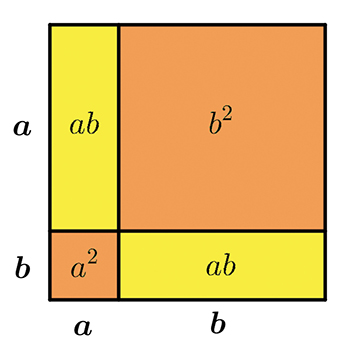
How can we calculate the area of the large square in the image below? Either by considering that its side has length a + b, which gives an area of (a + b)2, or by adding up the areas of each of the four pieces that make it up, which gives a2 + 2ab + b2.
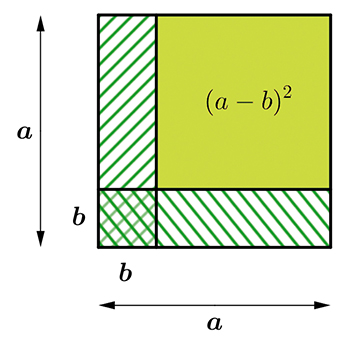
Viewing the same figure in a different way shows that (a – b)2 = a2 – 2ab + b2. Indeed, the area of the green square, with side a – b, can also be obtained from that of the large square with side a. We need only subtract the area of the two large hatched rectangles, each of area ab. The area of the small square with side b, hatched twice, has then been removed one time too many. This is easily corrected by writing that the area of the green square is ultimately equal to a2 – 2ab + b2.
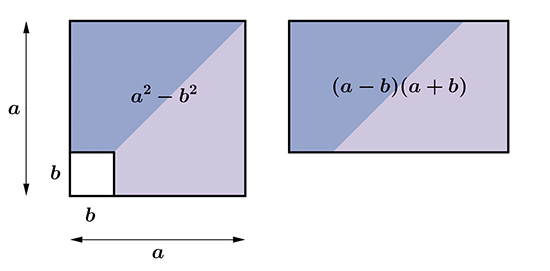
The third classic algebraic identity can also be derived by dissection. Here the picture speaks for itself: you need only reassemble two trapezoids into a rectangle.
In space too!
========================================================================
The dissections carried out in the plane can also be performed in space. For example, we can cover a cube with side a with a few well-chosen blocks to obtain a cube with side a + b. This gives the expansion of (a + b)3.
** a3. a3 + 3a2b. a3 + 3a2b a3 + 3a2b + 3ab2 + b3 **
** + 3ab2. = (a + b)3**