Quadratic equations—that is, equations involving the square of the unknown—have been studied for millennia. Particularly ancient examples appear on Mesopotamian clay tablets, which still bear delightful problems more than 3,500 years old. The ideas developed at the time already had real substance, but modern mathematical notation allows us to grasp even more clearly the power of standard identities in solving these equations.
Let's dive straight in with an example. How can we find the solutions of the equation x2 + 3x + 1 = 0? To anyone who does not remember ever tackling such questions, the problem may seem rather intractable. And yet, all we need to do is spot where an algebraic identity is hiding. Don't see it? No wonder: it is not complete yet! First, let's rewrite our equation as x2 + 3x = –1, and then examine the left-hand side.
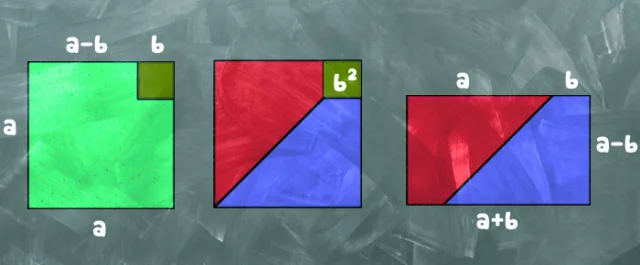
Remember: (a + b)2 = a2 + b2 + 2ab.
A closer look reveals that x2 + 3x is the beginning of an algebraic identity: