



BERTRAND HAUCHECORNE
179 articles published in Tangente
 History and CultureN°206Jun 21, 2022
A genius off the beaten track
In the scientific world, Bertrand Russell is known first and foremost as a logician and philosopher. His contribution cannot be understood without grasping the major shift then taking place in the development of mathematics: this was the era of the "foundational crisis."
Read → History and CultureN°206Jun 21, 2022
Alfred Whitehead, the collaborator behind the scenes
Russell's fame has overshadowed Whitehead's immense contribution to the development of logicist theories. The two men wrote the Principia Mathematica together.
Read → History and CultureN°206Jun 21, 2022
Ludwig Wittgenstein,
Born in Vienna in 1889, Ludwig Wittgenstein began studying mechanical engineering in 1906. Drawn to mathematics, he initially explored its applications before becoming fascinated by Russell's writings.
Read → History and CultureN°206Jun 21, 2022
A body of politically engaged writing
Bertrand Russell's literary writings range widely; they are tinged with philosophy, politics, and sociology. What unites them is that they all have a message to convey.
Read → Math for everyoneN°82May 19, 2022
The building blocks of Galois theory
Although inspired by Galois's work, "his" theory developed long after his death and did not take off until algebraic structures were introduced.
Read →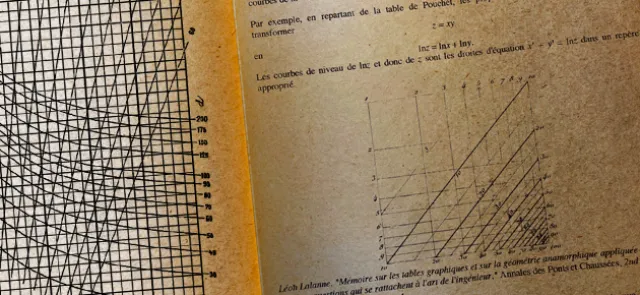 History and CultureN°205Apr 19, 2022
Nomograms
Arithmetic and geometry, the two traditional branches of elementary mathematics, come together in nomograms. But what exactly does this term, evidently derived from Greek, mean? What are nomograms used for, and how are they designed?
Read → History and CultureN°204Feb 17, 2022
Convexity and inequalities
Convex functions arose in analysis as a means of proving inequalities
Read → KnowledgeN°204Feb 17, 2022
Useful functions in analysis
With a graph that "looks skyward," convex functions give us reason for optimism. More seriously, first introduced to prove elegant inequalities, they have shown their importance far beyond mathematics. But what, exactly, are the properties of convex functions?
Read → Math for everyoneN°81Feb 15, 2022
So far, so near…
What is the distance between Paris and Rome? Faced with this question, one may legitimately wonder whether this means "as the crow flies," "by train," "by car," or "in the Euclidean sense." Ultrametric distances even reveal a world in which every triangle is isosceles.
Read →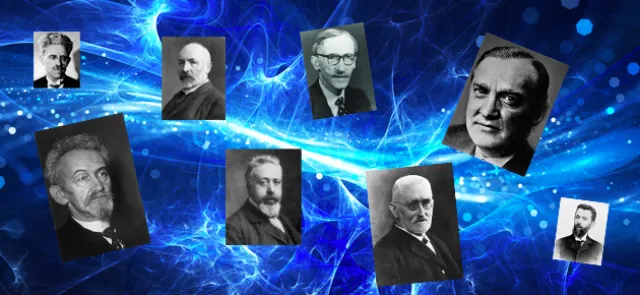 Math for everyoneN°81Feb 15, 2022
The genesis of metric spaces
In the early 20th century, Maurice Fréchet and Felix Hausdorff felt they were discovering a new world: set theory provided the framework in which they introduced the concept of distance, a generalization of absolute value on the real numbers.
Read → History and CultureN°80Nov 18, 2021
The language of groups
The word "group" was introduced by Évariste Galois himself in the 19th century, without a precise definition. The emergence of this concept called for a new vocabulary.
Read → History and CultureN°80Nov 17, 2021
Early formalizations
Évariste Galois's tragic death lent an epic quality to the introduction of the group concept in mathematics. What followed is less familiar but fascinating, culminating in brilliant theorems that are still taught today. Sixty years later, the notion of a group was finally established.
Read →