When we speak of the separation between two objects that are "relatively close," we mean the Euclidean distance. Yet when we speak of the distance between two cities, that is not what we mean at all. Because the Earth is round, the distance as the crow flies is the length of the shorter of the two arcs of the Earth's great circle joining the two places (see In Brief, "Distances on a sphere"). The distance given by your car's GPS, meanwhile, takes the road network into account (see In Brief, "GPS and the shortest path"). But what is the point of developing the notion of distance in mathematics?
An axiomatic definition
--------------------------
It seems reasonable to begin by saying that the distance between two points is a positive real number. We therefore call any map δ a distance if it assigns to every pair of elements (a, b) of a set E a non-negative real number, denoted by δ(a, b)… but that is not enough.
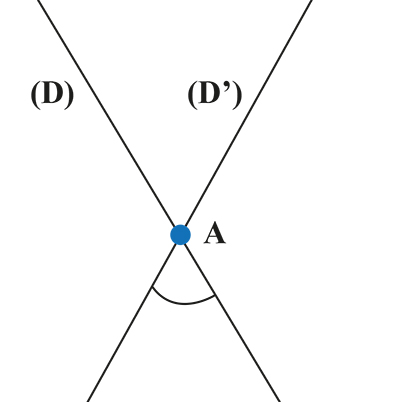
One possible distance on all the lines through a given point A.