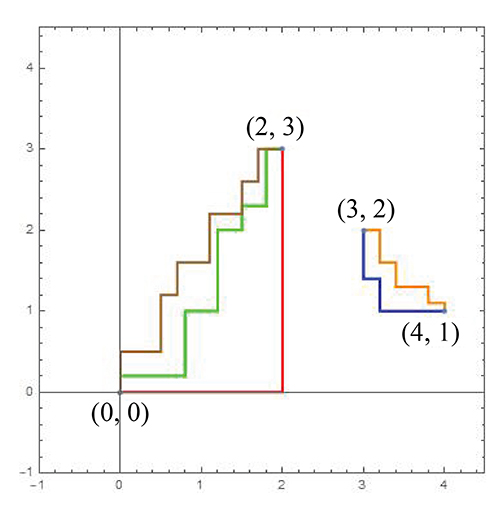
The usual distance—the one for which the shortest path between two points M1 and M2 in the plane is a straight line—is the Euclidean distance; here we denote it by d (M1, M2). But many other distances can be defined. In the familiar plane equipped with an orthonormal coordinate system, we associate each point with its coordinates, given by a pair of real numbers (its x-coordinate and y-coordinate). Each distance under consideration has associated "balls": a ball with center M0 and radius r is the set of points whose distance from M0 is less than or equal to r. This generic term is used in every metric space. Here, the balls lie in the plane: for example, the balls associated with the Euclidean distance are disks.
Built from horizontal and vertical lines
----------------------------------------
Let's begin with a distance associated with a norm, the 1-norm. If M1(x1, y1) and M2(x2, y2) are two points in the plane, the distance d1 between them is defined by:
d1(M1, M2) = | x2 – x1| + | y2 – y1|.
It is easy to prove that d1 satisfies the three conditions required of a distance.