



Fabien Aoustin
140 articles published in Tangente
 Math for everyoneN°178Sep 27, 2017
Area briefs
Discover different ways to calculate the areas of polygons
Read → Math for everyoneN°63May 25, 2017
Another transformation: inversion
Isometries (and more generally similarities) are not the only plane transformations that can be easily described using complex numbers. The same is true of inversion.
Read → Math for everyoneN°63May 25, 2017
Some interesting similarities...
Isometries can be studied very neatly using complex numbers. But they are not the only transformations that can be described by simple formulas! Once we dispense with preserving lengths, the vast family of similarity transformations opens up before us.
Read → Math for everyoneN°63May 25, 2017
Isometries of the plane
Studying isometries of the plane—reflections, translations, rotations, and so on—can sometimes be dizzying. What happens to a point or figure when several transformations are applied in succession? Complex numbers provide a representation that is as elegant as it is illuminating.
Read → History and CultureN°63May 25, 2017
Conjugates, moduli and arguments
Once we accept the existence of a number i such that i² = −1, do we risk losing touch with physical reality? Quite the opposite: a profound and fruitful correspondence emerges, allowing questions of pure geometry to be solved through simple algebraic manipulations.
Read →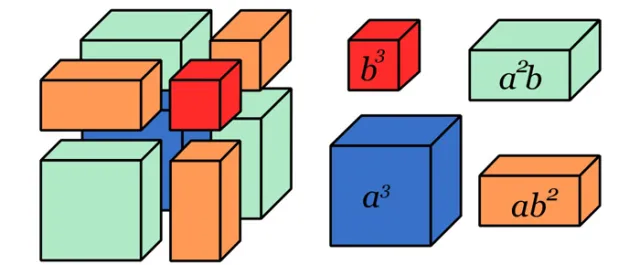 Math for everyoneN°175Mar 27, 2017
From algebraic identities to useful applications
The standard identities studied in middle school (and now at the start of high school…) can prove very useful in finding the solutions to certain equations, including quadratics. The trick is knowing where these mysterious identities are hiding!
Read → Math for everyoneN°175Mar 23, 2017
What is an algebraic identity?
Algebraic identities are a great classic of the high-school curriculum. Here's a quick refresher, in pictures…
Read → Math for everyoneN°173Nov 22, 2016
A “little” theorem for major advances
Fermat's “little” theorem is surely one of the most fruitful results in arithmetic. Ever since it was first stated in 1640, mathematicians have made constant use of it. Euler even proposed a sweeping generalization. Let's take a closer look…
Read → Math for everyoneN°61Oct 06, 2016
Dazzling binary relations
All people are born free and equal in rights. Yet someone like Coluche could add, not without mischief, that "some are more equal than others"! Defining an order, or an "equality" of some kind, requires us to establish precisely what these notions mean.
Read → Math for everyoneN°61Oct 05, 2016
The rules of infinity
You cannot play with sets without abiding by certain rules...
Read →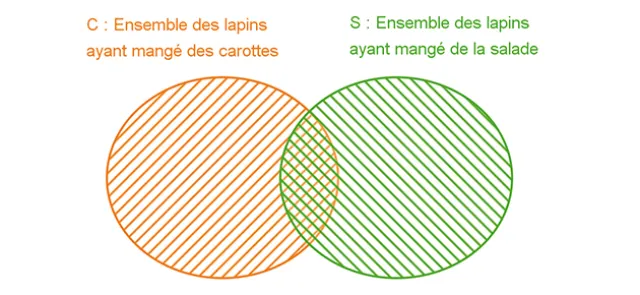 Math for everyoneN°61Oct 05, 2016
Potato diagrams: a chipper idea
When considering several subsets of the same set, it can be difficult to distinguish their various intersections. Representing these subsets as "potato-shaped blobs" often makes things clearer—and keeps us from looking like potatoes when faced with questions that are simpler than they seem.
Read → Math for everyoneN°61Oct 05, 2016
The paradoxes of infinity
Infinity must be handled with care, lest we lose ourselves (in its paradoxes)...
Read →