



Curiosity
Patterns, crafts, magic squares and fun mathematical content not part of the school curriculum

Promoting reliable science communication | Tangente
Since 1968, the French Association for Scientific Information (AFIS) has published the quarterly magazine Science et Pseudo-Sciences. Its aims are to promote science and combat those who invoke its name as a cover for quackery.

Meet Fabien Durand, president of the SMF | Tangente
At the end of last June, the Société mathématique de France (SMF) elected mathematician Fabien Durand as its new president. He enthusiastically agreed to speak with the editorial team at Tangente.

Vaughan Jones, the knot magician
The mathematician Vaughan Jones, who died on September 6, 2020, profoundly influenced several areas of mathematics, including topology and functional analysis, as well as physics, particularly quantum theory. His name remains associated with powerful invariants in knot theory.

Proof desperately wanted | Tangente
One hundred thousand results are stated worldwide each year—but how many of them are proved? In number theory, for example, many problems remain unsolved. Some are well known to enthusiasts, others less so...
A century of conjectures
Mathematics has always advanced through the curiosity of people seeking to answer new questions and pose new problems. Once solved, these give rise to others, creating an endless chain of advances in knowledge.

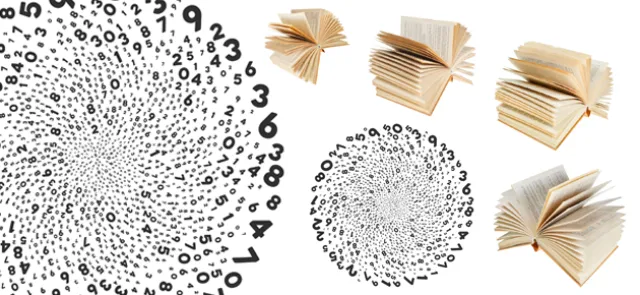
A spiral of digits | Tangente
An entertaining blend of arithmetic and graphics lets us display the successive terms of an arithmetic sequence visually. This calls for some explanation—and decoding!

The thousand-and-first tale | Tangente
Mise en abyme is a classic literary device that masterfully evokes an iterative process. One example is Olivier Salon's 2009 text Les Gens de légende, reproduced by kind permission of Éditions du Castor Astral.
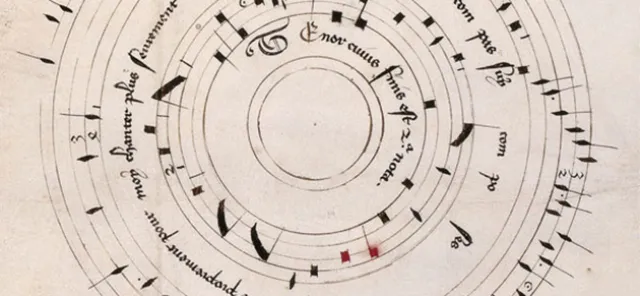
Musical iterations | Tangente
The first iterative process in music gave rise to the Pythagorean scale. Since then, recursive processes have been widely used in musical composition, from Johann Sebastian Bach to contemporary music. Their use is limited only by composers’ imaginations!

The online encyclopedia of integer sequences | Tangente
Founded in 1995 by British-American Neil Sloane, the OEIS (On-Line Encyclopedia of Integer Sequences) is a collaborative website where anyone can add a new way of generating a sequence of numbers, together with its known properties and the questions it raises. Nearly 400,000 sequences can be browsed there!

Computational geometry: key challenges | Tangente
It is easy to overlook, but many geometric problems can be solved by iterative methods or, more broadly, algorithms. These questions are the subject of computational geometry! This is a vibrant, highly active field in which many seemingly elementary questions still await solutions.

News from the Collatz conjecture
Syracuse... For some, the name evokes a classic song performed by the late Henri Salvador (1917–2008); for mathematics enthusiasts, however, it refers to the Collatz conjecture, whose statement is very simple but which remains unproved to this day. A recent result lends further support to the conjecture.
Happy is one who, like a number... | Tangente
Starting with an integer, apply a simple rule to obtain a new number. Repeat the process with the result, and so on... Depending on the pattern followed by this sequence—cyclic, constant from some point onward, and so on—the starting number is described as happy, perfect... But sometimes the pattern is still unknown.

Iterative processes at the heart of mathematics | Tangente
Repeating computational or logical procedures is one of the defining features of mathematical activity. The advent of computing gave fresh impetus to this technique, which has been used since antiquity.
A sequence of ideas: Ulam and Recamán | Tangente
Algorithms for constructing integer sequences from a given number are diverse. Many were devised in the 20th century by well-known mathematicians (Ulam, Kaprekar, Sloane...) and sometimes produce surprising results, some of which remain conjectures.
Editorial | Tangente
Iterate, iterate... As the Shadoks proclaimed in their day, only by trying again and again do we eventually succeed. In other words, the more often it fails, the greater the chance that it will work. This may raise a smile, yet iterative processes prove to be as simple as they are effective.
When an error bears fruit
Many mathematicians have made mistakes, whether through inadvertence, a miscalculation, a flaw in a proof, or a temporarily mistaken belief.

Little square puzzles | Tangente
Square-grid number puzzles appeal to enthusiasts of recreational mathematics. This selection comes from the "Affaire de logique" column in the newspaper Le Monde.

Marvelous logarithms
Logarithms emerged at the very beginning of the 17th century, thanks to the eccentric Scottish mathematician and theologian John Napier. By dramatically speeding up calculations, they paved the way for extraordinary scientific advances, particularly in astronomy.
Albert Ayme | Tangente
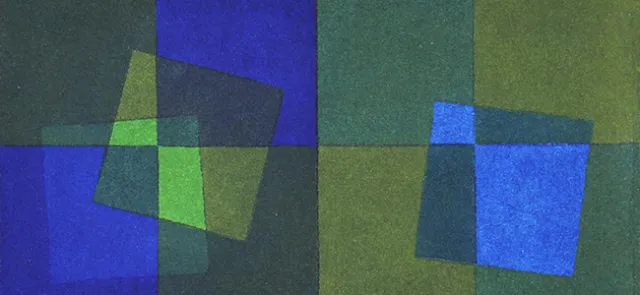
Albert Ayme left his engineering post in 1960 to devote himself to painting and sculpture. His scientific training led him to devise a combinatorial system of variations on the square, combining visual pleasure with mathematical rigor. He made the square magical!
196: a very curious number! | Tangente
A palindrome, or palindromic number, reads the same from right to left as from left to right, like 514,415. Here is a simple recipe for finding one.