



Multiple uses
The richness of curves is exploited in many fields. In mathematics, they have served to solve geometric problems, sometimes impossible with a ruler and compass, such as the trisection of the angle or the duplication of the cube. More generally, their visual character gives rise to a thousand enigmas, problems or conjectures. What is the ideal shape of a branch for a vehicle to travel on it? If many curves come from the observation of movements, conversely, others make it possible to provide solutions to problems in astronomy or physics. And, like all beautiful geometric ideas, they have their own aesthetic that is found with joy in art or design.
All articles in this folder
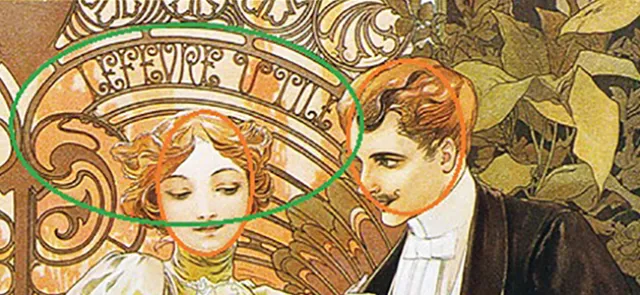
Art Nouveau: a movement of curves | Tangente
Art Nouveau was a total art movement that flourished across several European countries in the late 19th century. Never before had an artistic movement placed such emphasis on the beauty and variety of curves.
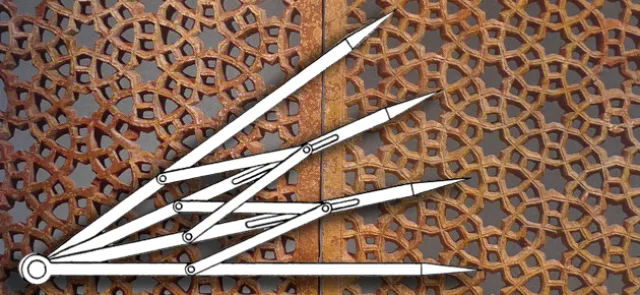
Curves that go beyond the compass
Even when some "natural" problems prove impossible to solve, mathematicians have found ways around them, producing approximations of varying accuracy. To do so, they have sometimes had to draw on a host of geometric tricks and devise ingenious mechanisms.
Parabolas and catenaries
The parabola and the catenary are two grand dames of geometry, both with the same open U-shape. The first was studied by the Greeks 2,500 years ago; the second, "only" 330 years ago, by 17th-century mathematicians.

Welcome to the world of virettes: Lissajous curves | Tangente
Marcel Guery explores the artistic potential of Lissajous curves
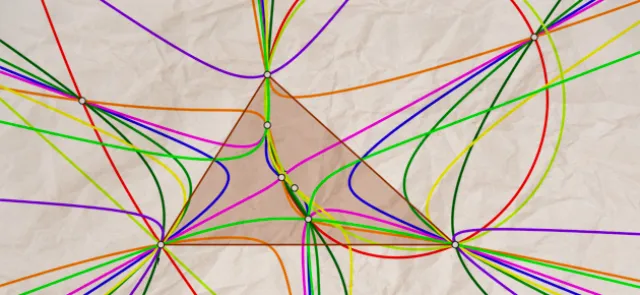
Triangle cubics
Beyond the centroid, the orthocenter and the centers of the two circles familiar from school geometry, thousands of points can be associated with the three vertices of a triangle. These myriad points lie on hundreds of cubics with remarkable properties.