Lissajous curves
-----------------
Lissajous curves m (a, b, φ) can be defined by the parametric equations x (θ) = Ra sin(a θ), y (θ) = Rb sin(b θ + φ), where a and b are two natural numbers (the parameters, or frequencies). For our purposes, a and b will be integers. R *a and R b are two positive real numbers, the angle θ ranges from 0 to 2π, and φ (the phase shift) ranges from 0 to π/(2a*). These curves were notably studied by the French physicist Jules Lissajous (1822–1880).
Fix a nonzero natural number a. The Lissajous curves m (a, a, π /2) trace circles, the curves m (a, 2a, π/2) are portions of parabolas, while m (2a, a*, π/2) trace distinctive figure eights.
In the author's terminology, some curves, called braids, have two axes of symmetry. Others, called horns, have two cusps and either an axis or a center of symmetry. The simplest horn is an arc of a parabola; the circle and the figure eight are the simplest braids. For φ = 0, if a + b is odd, the curve is a braid; if a + b is even, it is a horn. If φ is increased by π/(2a), a braid will be followed by a horn, and vice versa.
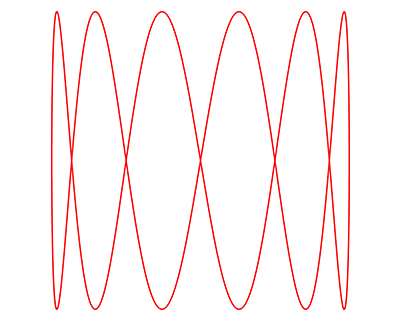
Lissajous curve with Ra =Rb =1, a = 1, b =6 and φ = 0.
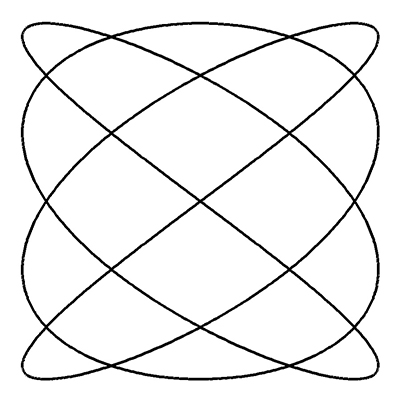
Braids have two axes of symmetry.
####
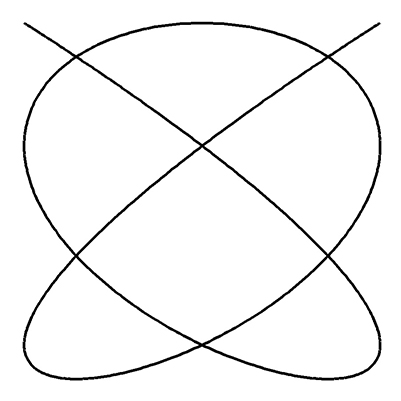
Horns have either an axis or a center of symmetry.
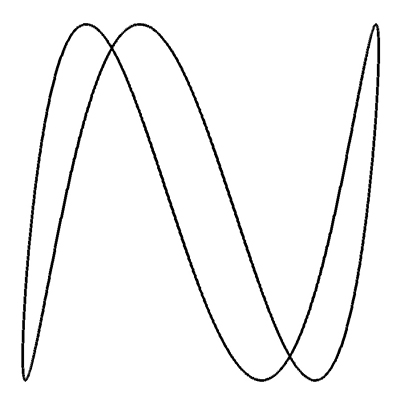
A Lissajous curve that is neither a braid nor a horn.
Monovirettes and bivirettes
---------------------------
In the author's terminology, a monovirette is a Lissajous curve m (a, b, φ). A bivirette, or two-layer virette*, is the sum of two Lissajous curves; its parametric form is therefore:
x (θ) = R a*1 sin(a1θ) + R *a*2 sin(a2θ), y (θ) = R *b*1 sin(b1θ + φ1) + R *b*2 sin(b2θ + φ2)
where a1, a2, a3, a4 are four integers.
For simplicity, we take R *a*1 = R *a*2 = R *b*1 = R *b*2 = 1 and φ1 = φ2= π/2.
Even the study of these "simplified" bivirettes raises interesting combinatorial questions (how many axes or centers of symmetry are there, depending on the frequencies?) and yields some striking curves.
In general, a k-virette, or k-layer virette, is the sum of k Lissajous curves. The larger k becomes, the more varied the resulting patterns—but the harder they are to study.
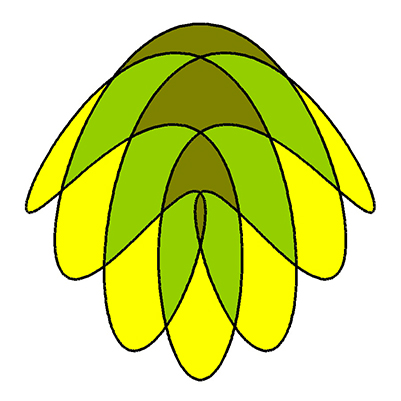
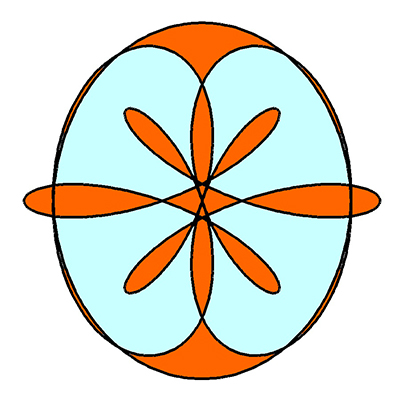
The bivirettes m ( 2, 2, π /2 ) + m ( 5, 7, π /2 ) and m ( 7, 7, π /2 ) + m ( 3, 5, π /2 ).
Striated virettes
-----------------
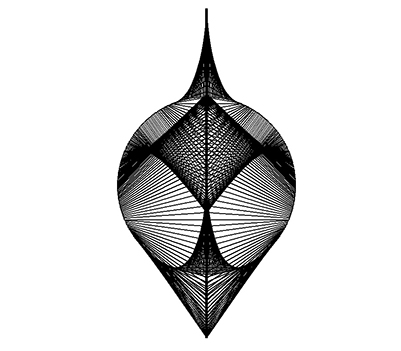
A striated virette, or striped virette (terms proposed by the author), is a k-virette with k ≥ 2 in which the constituent Lissajous curves are connected by striations (between the first curve and the sum of the first two curves, for values of θ evenly spaced between 0 and 2π). Visually, these curves sometimes create an impression of depth that may appeal to artists and graphic designers.