



When geometry and combinatorics get involved
Graphs and probability are not the only areas of mathematics that board games draw upon. Geometry, and even topology, often come into play when it comes to placing pieces of various shapes on a board. Combinatorics is also, of course, the key to many games. But we must not forget number theory, which often makes it possible to imagine models of the relationship between certain game situations and numbers associated with them.
All articles in this folder
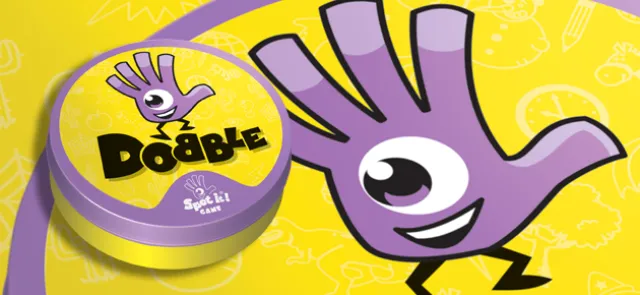
The projective geometry behind the Dobble game | Tangente
You would never guess it while playing Dobble: combinatorics, projective geometry and modular arithmetic can offer a new approach to constructing the game's various variants.
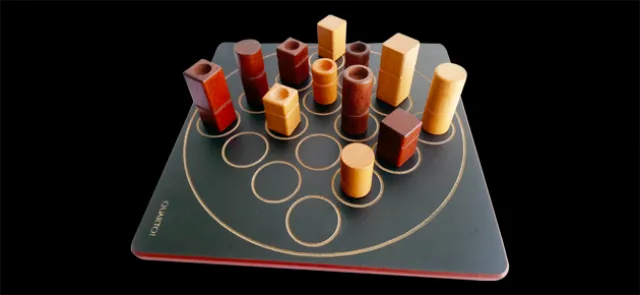
Quarto!: Combinatorial reasoning and strategy | Tangente
Shape, color, size and topology (with or without a hole) are the four characteristics of a Quarto! piece. Since each has two possible values, the players facing off in this thrilling combinatorial game — one of the most award-winning in the world — must contend with sixteen pieces.
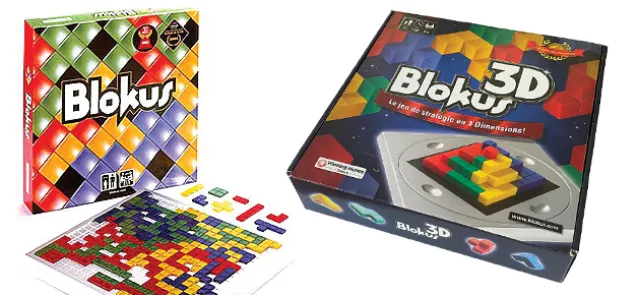
A family of five games: Blokus and its variants | Tangente
What's presented here isn't a game of five families, but a family of five games (siblings and cousins!) — blocking games, in which a player leaves the game once they can no longer play. All of them concern geometry. In particular, the pieces in these games take many forms, made up of squares, triangles, line segments and cubes.
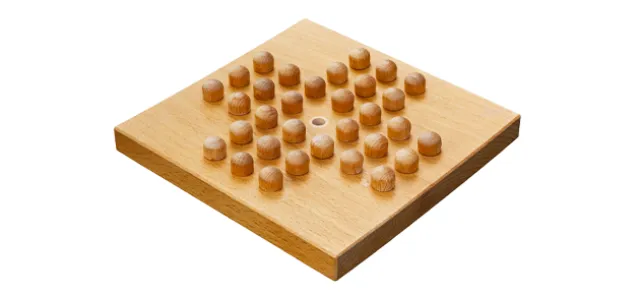
Solitaire on a line
Are solitaire games board games? Whatever answer you give to that question, this article and the next show that their mathematical treatment is in no way inferior to that of multiplayer games.

The Mathematics of Tchoukaillon
Mancala is the generic name for traditional sowing games in Africa and Asia. One of the solitaire variants of these games gave rise to a mathematical recreation with unexpected properties and consequences.