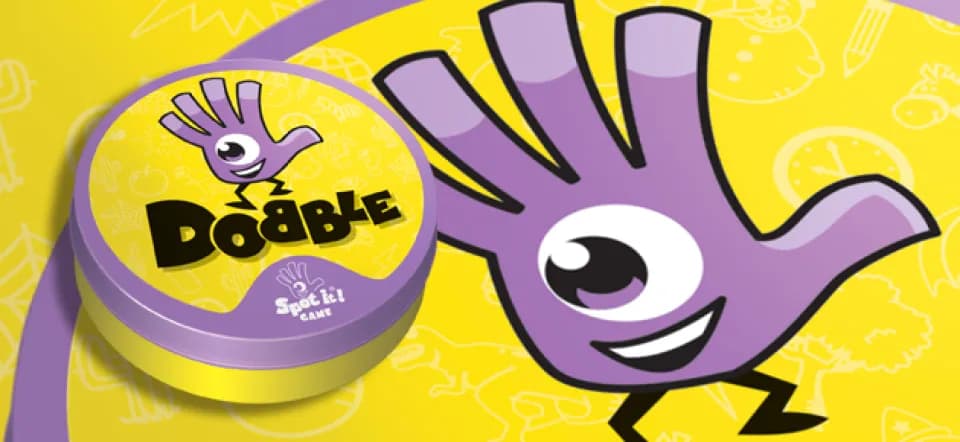
The classic Dobble game (Play Factory, 2009) consists of fifty-five cards, each bearing eight different symbols. Several sets of rules exist, all resting on the following feature: if two cards are chosen at random from the game, they share exactly one symbol.
In the main variant, a card is turned face up in the middle of the table, and each player, holding a card of their own, must find the symbol common to their card and the one in the center as quickly as possible. Whoever finds it first wins the visible card, which is then replaced by another, and so on.
This game raises many natural questions. How are the cards constructed? Can any number of symbols per card be chosen? Once that number is fixed, how many symbols are needed in total, and how many cards can be created? These questions* draw on a number of ideas from combinatorial mathematics.
In what follows, we will denote by q the number of symbols per card, c the number of cards in the game, and s the total number of distinct symbols used. We will also write n = q – 1; this integer plays a decisive role in answering the questions raised. In classic Dobble, q = 8 (and so n = 7), c = 55 and s = 57.
A surprising analogy