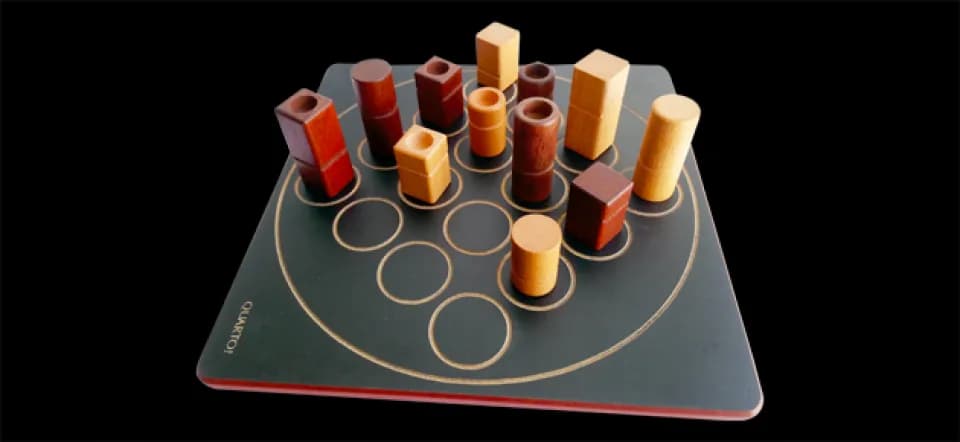
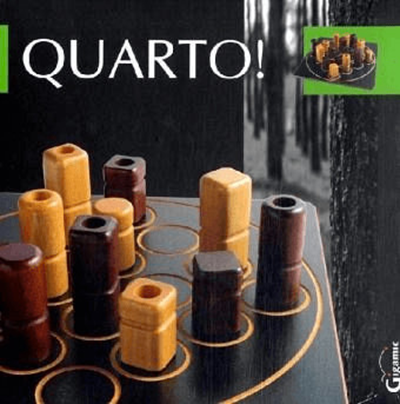
The game Quarto!, originally called 4 × 4, created by Blaise Muller in the early 1980s, has been published since 1991 by Gigamic. Built on observation and continuous analysis of a situation that evolves with every piece placed, it is one of the most highly awarded games. It won a prize in 1985 at the Concours international de créateurs de jeux de société in Boulogne-Billancourt, and received the Dé d'or des créateurs de jeux in Paris in 1989. In 1992 it won the Super As d'or at the Festival international des jeux de Cannes, and in 1993 the Mensa Select Top 5 Best Games award in the United States, among many other honors.
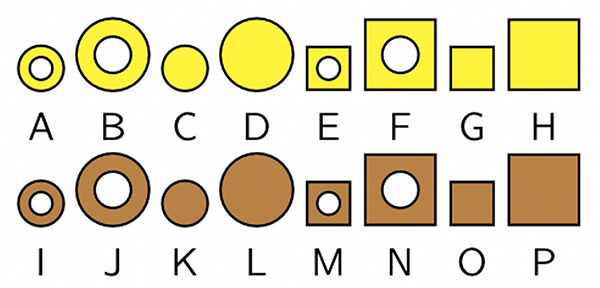
Looking more closely at the pieces, we notice that they can be sorted by four criteria: color (light or dark), shape (square or round), size (large or small), and "fill" (the piece is solid or hollow). The game therefore has 24 = 16 different pieces, shown symbolically below and given a letter code to make the rest of the article easier to follow.
The rule is very simple. The pieces are placed on a square 4 × 4 board. To win, you need only line up four pieces that share the same value for one of the four criteria listed above. This is a quarto!