Solo challenges
--------------------------
Your friends are on their fifty-ninth game of beach ball and you're getting a little bored on your towel? A single small pebble will be enough to keep you busy. A shell will do just as well. Draw a cross made up of twelve squares and place your pebble in the square of your choice. Can you visit all twelve squares by moving your piece like a chess knight? Here's another classic puzzle, this time with a nine-square grid. Place two light-colored pebbles in two corners of your choice and two dark-colored pebbles in the other two corners. Can you swap the two pairs of pebbles, again using only the knight's move?
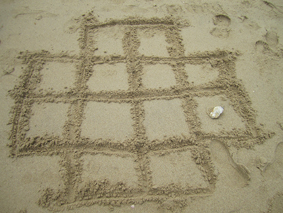
Visit each square exactly once, moving like a knight, and return to the starting square.
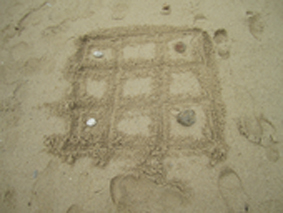
Swap the light and dark pebbles by moving like a knight.
A topological classic
------------------------
The sandy beach is also a wonderful setting for the game of sprouts (that is, "shoots" or "buds"). This game was invented in 1967 by John Horton Conway and Michael Stewart Paterson. Place n pebbles on the beach. Taking turns, each player draws a curve between two pebbles and adds a third pebble on this new curve. But watch out: two rules apply — no curve may cross another (or itself), and no more than three curves may leave any single pebble. The last player able to move wins. It is conjectured that if the remainder when n is divided by 6 is 3, 4 or 5, the first player has a winning strategy (and that otherwise it is the second player who can win). No one knows how to prove it!
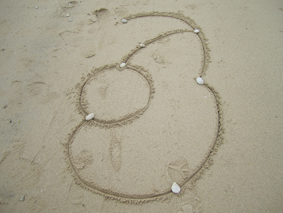
Who will win this game of sprouts?
Two-player strategy games
----------------------------
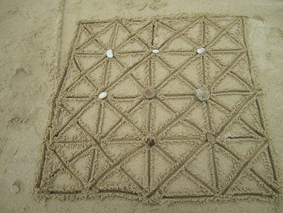
To begin, find three light-colored pebbles and three dark-colored pebbles. Draw the game board in the sand: a square, its diagonals and its midlines. Each player, taking turns, places their pieces at the intersections of the grid. If neither player has managed to line up their three pieces, play continues with each player, in turn, moving one of their own pieces along the lines of the grid. Can you find a winning strategy? If each player finds one more pebble on the beach, another game (subtler than it looks) becomes possible: Teeko. The game grid consists of a 5×5 square of twenty-five cells. The goal of this game, created by the American magician John Scarne (1903–1985), is to line up their four pieces or arrange them in a small square. Each player places their pieces in turn, however they like. If the game is not yet won, play continues by each player, in turn, moving one of their pieces to an adjacent square (horizontally, vertically or diagonally).
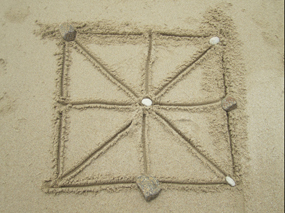
The "small square" game. The white player has just made their move. Did they make a good choice?