"The sun never sees a shadow," said Leonardo da Vinci, showing that the concept of shadow was already important in his time. Yet it had acquired significance long before him, having been used to measure inaccessible heights: ancient surveyors had understood that seeing an object's shadow already gives some idea of its dimensions. During the Renaissance, shadows became a tool for theorists of perspective, who knew that seeing an object's shadow already means recognizing it to some extent—and therefore knowing how to draw it with the illusion of reality, or, as we would say today, "in 3D."
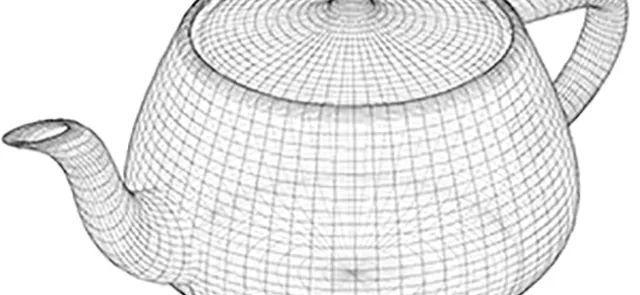
Several centuries later, computer scientists used self-shadowing to convey objects' three-dimensional form on screen: who could forget the famous "Utah teapot," created by Martin Newell in 1975 and now a genuine cult object in the world of computer graphics? The concept of shadow therefore has a profound influence on how we perceive the space around us.
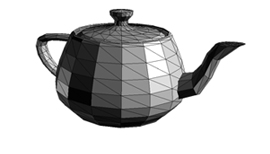
A famous computer graphics model: the Utah teapot.
Shadows in sunlight
-------------------
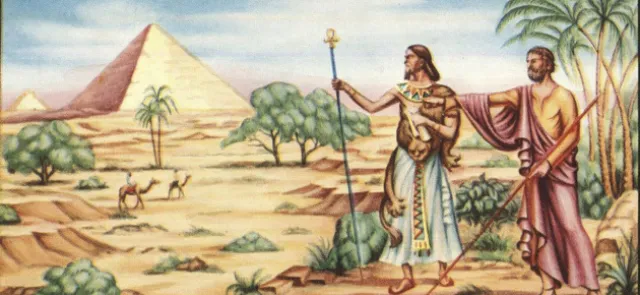
Using shadows cast by the sun to measure inaccessible distances is an ancient practice, dating back to around the 6th century BCE. Several sources report that Thales not only travelled to Egypt but also measured the height of the pyramids "by observing the length of their shadow at the moment when our own shadow is equal to our height." The idea? Because the sun's rays are parallel, we can use triangles—what we will later call similar triangles. The method? According to Plutarch, Thales showed, "by planting a stick at the end of the pyramid's shadow and forming two triangles through the action of the sun's rays, that the pyramid bore the same ratio to the stick as the pyramid's shadow did to the stick's shadow." Carrying out the calculation gives:
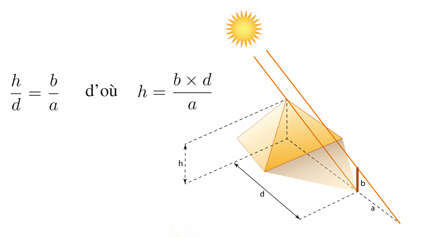
Since the sun's rays are regarded as parallel, a shadow is precisely the image of an object under parallel projection onto the ground—in other words, its drawing in parallel perspective. Knowing a shadow means already knowing how to move from three-dimensional space to the plane, and thus how to draw in perspective. The shadow of a line segment is always a line segment, and midpoints are preserved. The construction then follows naturally.
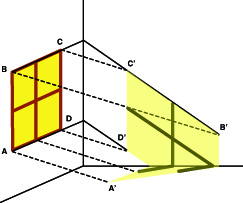
Sunlight streams through the window. The window with panes ABCD projects an illuminated area A'B'C'D' onto the adjacent wall, while its glazing bars cast shadows.
Shadows by torchlight
---------------------
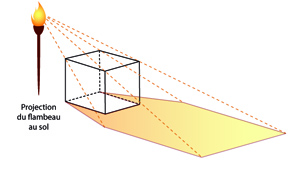
The situation is different for a shadow said to be cast by torchlight, because here all the light rays originate from a single point, the torch. But knowing how to draw the shadow cast under these conditions means knowing how to draw an image by central projection. Shadows by torchlight thus correspond exactly to central perspective, so well illustrated by Dürer (1471–1528) with his device known as the Dürer window: a sighting hole fixes the position of the operator's eye, with a window placed between that eye and the object to be depicted. Each point of the object is represented by the intersection of the window's plane with the light ray joining that point to the eye, just as the shadow of a point is the intersection of the ray emitted by the torch and passing through that point with the plane of the screen—the wall, the ground or any other flat surface—onto which the shadow is cast.
The techniques of shadow drawing, which "flatten" a given three-dimensional object into two dimensions, are therefore also those of perspective drawing: it always pays to know how to draw (lines) faster than your shadow…