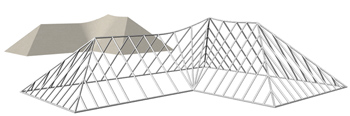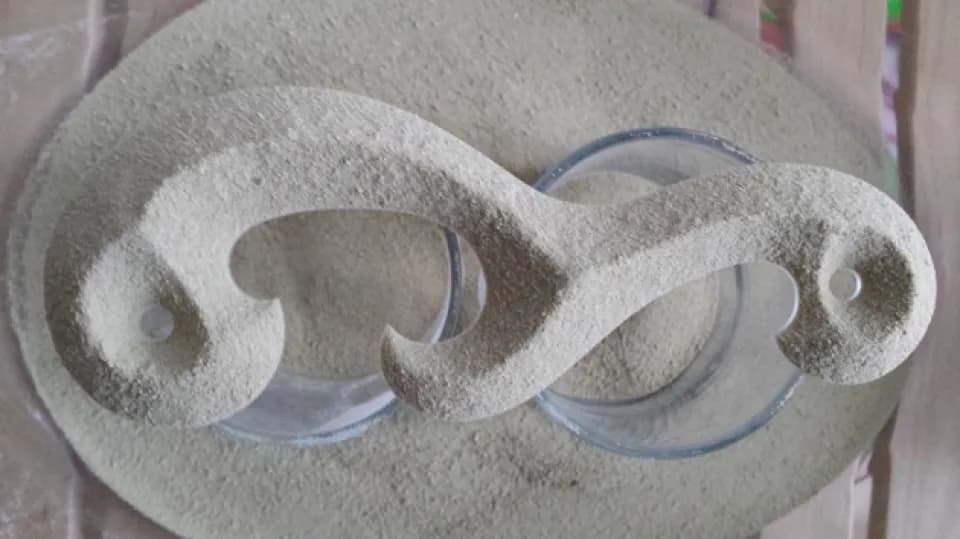
What is a sandpile? The question may sound innocuous, but we have to start somewhere! For our purposes, we gently pour fine, dry, uniform sand onto a piece of rigid cardboard propped up so that it is level (the base) until the pile is saturated. In other words, not a single grain can be added to the pile without rolling down the slope. The slope has then reached a critical value, the same at every point on the pile, which is why it is called a constant-slope surface.
A keen sense of geometry
----------------------------
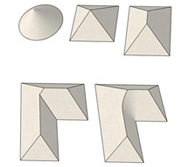
Let us begin with some preparatory hands-on work. Cut a variety of bases from cardboard—a circle, square, rectangle, convex or non-convex polygon, or free-form shape—and observe what happens. As expected, the circle produces a cone of revolution, the square a pyramid, and the rectangle a roof whose four faces all have the same pitch. But here is the surprise: if we try to reproduce exactly a roof made entirely of flat surfaces over an L-shaped building, the sand refuses to cooperate! In the re-entrant corner formed by two roof faces, the sand continues to accumulate until it forms a conical surface (part of a cone of revolution), and a curved ridge line appears, comprising line segments and two elliptical arcs.