



Mathematical Themes
Explore the major mathematical themes: geometry, algebra, analysis, arithmetic, logic, and many other fascinating fields.

Adrien-Marie Legendre, in search of integer solutions
The search for integer or rational solutions to algebraic equations has left its mark on the history of mathematics. The law of quadratic reciprocity, stated by Legendre, which determines whether a number is a square "modulo a given integer," advanced this field.

Theatre and maths with Compagnie Terraquée | Tangente
François Perrin, an actor, director and mathematician, and Meriem Zoghlami, a creator of unconventional cultural formats, lead Compagnie Terraquée. Exactly ten years ago, they founded its Mathéâtre lab. In 2017, the company devised a major festival, "Maths en ville".

Catalan numbers
Eugène Charles Catalan (1814–1894), the son of a Parisian jeweler, was born in Bruges, Belgium. A brilliant student, he entered the École polytechnique in 1833, where he befriended a teaching assistant who would later become famous: Joseph Liouville.

Sophie Germain primes | Tangente
From Fermat's Last Theorem to cryptography, Sophie Germain primes have played a part in many scientific adventures over the past two centuries. These prime numbers have earned their place in the pantheon of arithmetic, yet we still do not know whether infinitely many exist.

Making counting easier | Tangente
Counting the elements of certain sets is not always straightforward. In the last century, William Burnside, a mathematician specializing in group theory, established a result that simplifies the calculation of the number of objects in certain finite sets.

Counting to exist: the political uses of... | Tangente
Counting seems straightforward enough: you count what is there. Nothing could be more childlike... or so it seems. Yet counting entails highly significant political choices and can serve extremely important economic, social and even identity-related purposes.

Convexity in geometry and analysis | Tangente
Convex geometry took off during the 1960s, particularly because of its applications in probability theory and optimization

A showcase of mathematical inequalities | Tangente
Mathematics abounds in inequalities, often drawing on differential or integral calculus. Many problems can be solved with their help. So let's explore them!

Sorting algorithms: complexity and methods | Tangente
When a collection of data contains different values, one common task is to sort them—that is, to arrange them in a given order: the usual numerical order, lexicographic order as in a dictionary, or any other order defined by a total ordering relation.

And order was established
The notion of order is part of our daily lives, whether we are putting objects away, comparing quantities or deciding what order to tackle a series of tasks in. Yet it took a very long time for these natural activities to be conceptualized mathematically.

A little order…: order relations in mathematics | Tangente
Dictionary words, like points in the plane, can be put in order. Each choice of method—alphabetical order, lexicographic order, and so on—corresponds to an ordering: it is up to each of us to choose the order relation that suits our needs!

Bienaymé–Chebyshev inequality in probability | Tangente
Summarizing a set of observations with a few key numbers is essential. But how much do these numbers tell us about the frequencies within particular intervals? The Bienaymé–Chebyshev inequality provides a first quantitative answer.

More means: harmonic and arithmetic | Tangente
The arithmetic, quadratic, geometric and harmonic means (among many others) are all examples of a general family: the power means. They satisfy a well-known chain of inequalities.

Cauchy–Schwarz in graph theory | Tangente
Take ten points and join some of them with line segments, but never form a triangle (that is, a triangle whose vertices are among the original ten points). What is the maximum number of segments you can draw?

Order amid disorder: rearrangement | Tangente
Take a random sequence of numbers. It is unlikely that they will all be in increasing or decreasing order from the outset. Can we nevertheless hope to extract perfectly ordered subsequences? Yes—but they may not be as long as we would like!

The birth of thermodynamics and Clausius | Tangente
The study of heat transformed our view of the world by prompting us to consider whether a physical "arrow of time" exists. It all comes down to one remarkably simple relation: the Clausius inequality.

Social inequality: the Gini coefficient | Tangente
Statisticians often publish averages, reducing a snapshot of a country's socioeconomic situation to a single figure. But these averages often (always?) conceal stark disparities. One way to bring them into sharper focus is to quantify inequality as well.
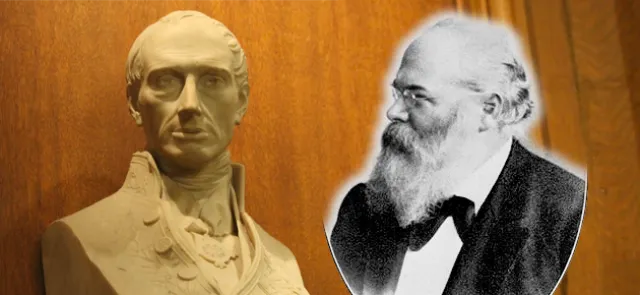
Cauchy–Schwarz inequality: proofs | Tangente
The Cauchy–Schwarz inequality takes many forms: arithmetic, integral and geometric; it even appears in probability theory. Let us trace its development, from Cauchy's numerical formulation around 1820 to its general form a century later.

Five variants of the Cauchy–Schwarz inequality | Tangente
The Cauchy–Schwarz inequality appears in several branches of mathematics: analysis, arithmetic, geometry, probability... It is so important that many widely differing proofs have been devised!

Tchebychev's inequalities for sequences | Tangente
Elementary results can sometimes prove astonishingly fertile, opening the way to a host of developments and applications. Chebyshev's inequality is a case in point.