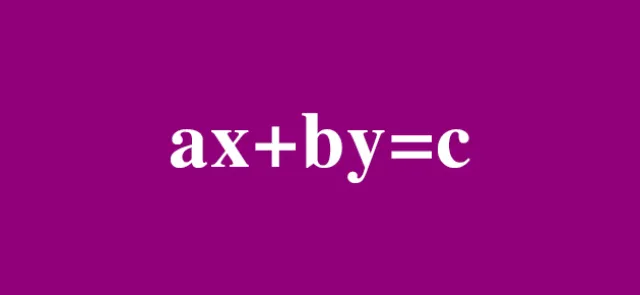
The statement that secured Bézout's place in history takes either the form of the Bachet–Bézout theorem (given two integers a and b, a and b are coprime if and only if there exist two integers x and y such that ax + by = 1), or that of an identity (there exist two integers x and y such that ax + by = d, where d is the greatest common divisor of a and b). The identity follows easily from the theorem. Yet the result was no "scoop" for either of the two mathematicians whose names are associated with it: the first proved it in his own way, and the second generalized it.
Bachet, the forerunner
Bachet de Méziriac was equally at home with poetry, ancient languages and mathematics, but today he is known chiefly for his Problèmes plaisants et délectables qui se font par les nombres (see box) and the solving methods he presented in it.
The idea behind the book was innovative: mathematical recreations, usually relegated to an appendix, were here the book's very subject. The author explained his own, often original problem-solving methods in detail. Rather than amusing problems used to illustrate serious theorems, these were recreational problems that prompted a search for mathematics useful for solving them.