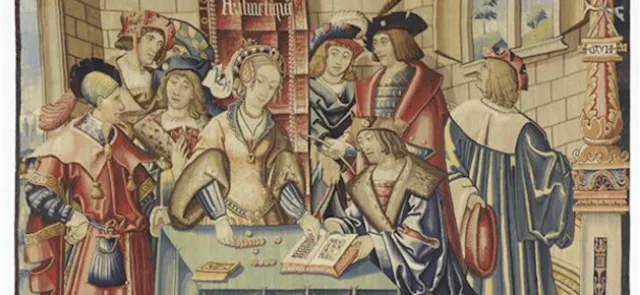
In 1776, the Scottish economist and philosopher Adam Smith published An Inquiry into the Nature and Causes of the Wealth of Nations ("An Inquiry into the Nature and Causes of the Wealth of Nations"), whose rather long-winded title is often shortened to The Wealth of Nations. Some economists regard it as the founding work of economic liberalism, which still underpins many systems today. In it, Smith develops his ideas about markets and money, emphasizing the benefits of the division of labor. According to Smith, the principle of natural liberty (sic.), combining free competition with free trade, would necessarily produce a system that serves the general interest, since it ensures that "the quantity of every other useful commodity, which the freedom of trade never fails to supply us with in the proper quantity, is preserved or increased, without any attention of government". To illustrate the division of labor, Smith develops the metaphor of a pin factory. Thus, "ten persons could make among them upwards of forty-eight thousand pins in a day. Each person, therefore, making a tenth part of forty-eight thousand pins, might be considered as making four thousand eight hundred pins in a day. But if they had all worked separately and independently, and without any of them having been trained for this particular task, they certainly could not each have made twenty pins".
That would seem to settle the matter: the arguments are compelling.
But Bertrand Russell did not agree.
In praise of idleness
----------------------
In a short piece published in the Review of Reviews in 1932, Russell set out his In Praise of Idleness. The philosopher and mathematician begins by challenging the notion that work is virtuous—a notion generally promoted by people who do not perform the same kind of tasks. For he distinguishes "two kinds of work: first, altering the position of matter at or near the Earth's surface […]; second, telling other people to do so. The first kind is unpleasant and ill paid; the second is pleasant and highly paid, and can be extended indefinitely: there are not only those who give orders, but those who give advice as to what orders should be given". So everyone is hard at work. But are there no idlers? Of course there are! Yet they owe their existence entirely to the industry of others: they are people of independent means and wealthy landowners. Their comfortable idleness is both a consequence of the work ethic and its historical source.