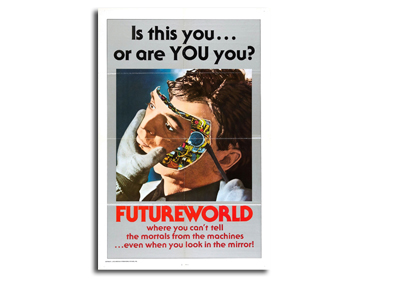
Richard Heffron's 1976 film Futureworld (American International Pictures) was the first to show the general public images generated from 3D models designed and animated on a computer. The technology has since become widespread: these are known as synthetic images, or computer-generated imagery (CGI). It is now widely used in audiovisual productions: video games, animated films and special effects, both in cinema and advertising... The quality of these images continues to improve, and they seem "more and more real." Yet the mathematical principles governing them remain the same!
Euler and his angles
--------------------
Everything begins with a virtual scene populated by various 3D objects—models of characters, vehicles, furniture and so on. This is a three-dimensional Euclidean space: the position of each model is specified by a vector consisting of three numbers, which describes its offset from the scene's central reference point. Position alone, however, is not enough to describe an object's presence completely: its orientation must also be specified. The orientation of a 3D object raises an important mathematical problem: how can angles be described in three dimensions?
In the 18th century, the mathematician and engineer Leonhard Euler devised a representation that would bear his name: Euler angles (see les Angles, Bibliothèque Tangente 53, 2015). These three numbers describe an orientation completely by means of three fairly intuitive elementary rotations. Try it for yourself: stand up and attempt to control the direction of your gaze. First, turn all the way around. Next, nod your head. Finally, tilt your head towards one shoulder. Congratulations—you have just performed Euler's three elementary rotations!