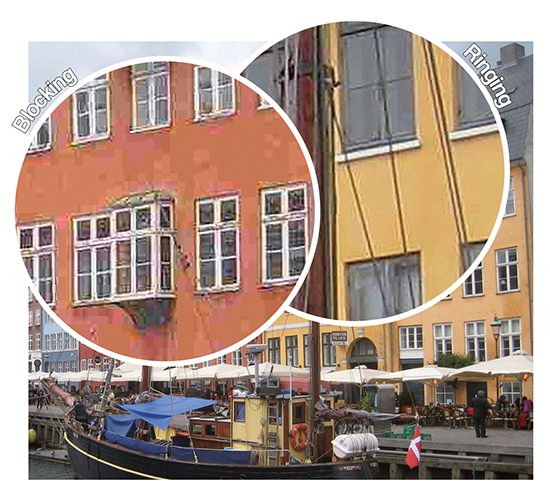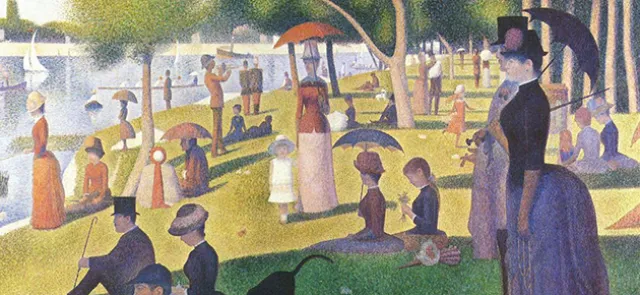
To meet our quality requirements using existing transmission methods, images must be compressed (see the article "Le format JPEG"). Despite the effectiveness of compression methods, some flaws can appear on screen; specialists collectively call them artifacts. One such defect, the Gibbs effect (or ringing, from the English word "ring," meaning "annulus," "circle," or "finger ring"), is a double edge that may appear between two areas of color, while reduced edge sharpness (blurring, from the English verb "to blur," meaning "to make indistinct") produces a blurred area on screen. These artifacts can appear even at low compression levels. As the compression level increases, blocks of pixels also begin to appear (a phenomenon also known as blocking, characterized by the appearance of blocks of uniform color in the image).