You are familiar with the so-called Euclidean line, an ideal geometric entity containing infinitely many points.
It has a certain self-evident quality: two points determine it, it obeys the axioms of classical geometry, and no one doubts what it is—everyone knows what we mean, even without a definition.
One line may conceal another
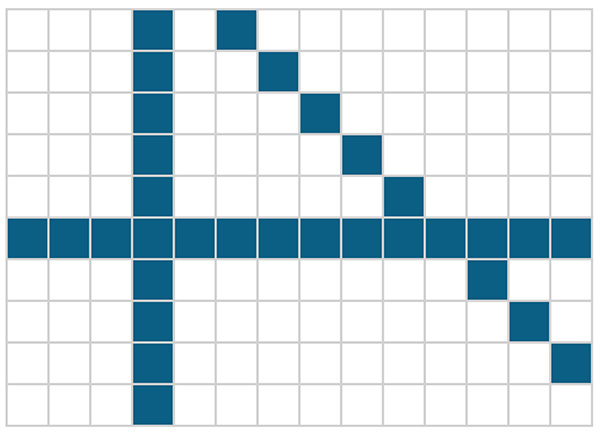
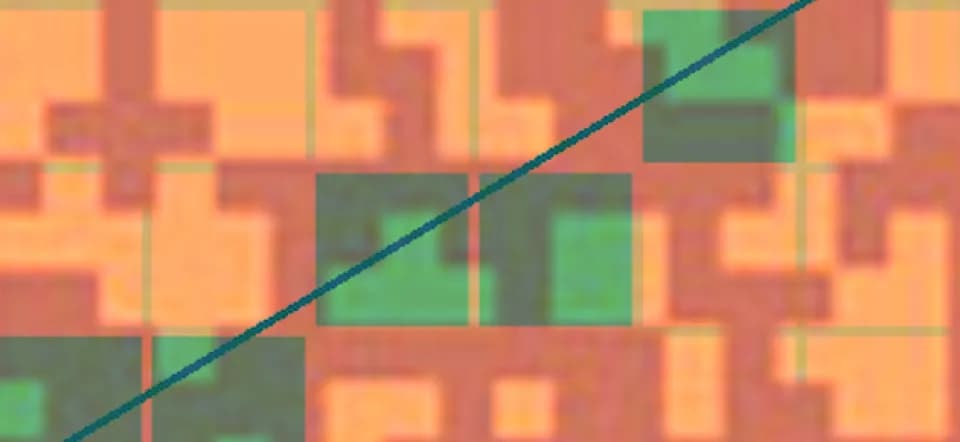
Instead, consider our lines not in Euclidean geometry but in discrete geometry. Recall that discrete geometry studies the properties and structures of geometric objects formed from a finite or countable set of points. Here, then, the only points that exist are those with integer coordinates. They can also be represented by a grid of pixels on a computer screen—for example, by taking the centers of the pixels to have integer coordinates.