Passer au contenu principal
Tangente
Subscribe
  • Featured
  • Magazines
Tangente
  • Featured
  • Magazines
Subscribe
  1. Home
  2. Articles
  3. History and Culture
  4. Heine and the rigorous study of functions
History and CultureBrief
Read in: English▾
  • Français

Heine and the rigorous study of continuous functions | Tangente

Heine and the rigorous study of functions

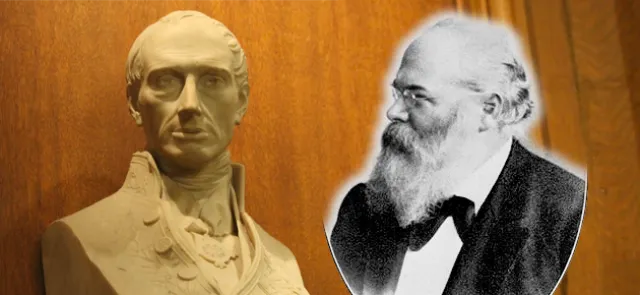
Eduard Heine is not among the best-known mathematicians, even though his name is attached to a theorem on the uniform continuity of continuous functions on a closed interval.


Written by
BH
BERTRAND HAUCHECORNE
PublishedMay 10, 2016UpdatedMay 16, 2026
Share
Heine and the rigorous study of functions
Should we abolish the baccalaureate?
Published in

Tangente

May 2016N° 170
Browse the issue

On the same theme

Articles recommended for you.

The emergence of discontinuous functions
Math for everyone

The emergence of discontinuous functions

Until the early 19th century, everything seemed continuous. Trigonometric series brought discontinuous functions onto the scene. They prompted Riemann to generalize the notion of the integral, led Weierstrass to clarify the notion of continuity, and spurred Darboux to study derivatives.

BERTRAND HAUCHECORNEJan 21, 2020
Cauchy–Schwarz inequality: proofs | Tangente
Math for everyone

Cauchy–Schwarz inequality: proofs | Tangente

The Cauchy–Schwarz inequality takes many forms: arithmetic, integral and geometric; it even appears in probability theory. Let us trace its development, from Cauchy's numerical formulation around 1820 to its general form a century later.

BERTRAND HAUCHECORNEAug 24, 2023
From intuition to rigor:
Knowledge

From intuition to rigor:

From Cauchy to Weierstrass, rigor steadily took hold in analysis throughout the 19th century. A variety of counterexamples swept away mistaken beliefs and forced mathematicians to define the relevant concepts more precisely. Some "monstrous" functions were introduced, fascinating to some and repellent to others.

BERTRAND HAUCHECORNEOct 12, 2021
The first law of large numbers
Knowledge

The first law of large numbers

Repeating a random experiment with two possible outcomes a large number of times leads to probabilities that are difficult to predict directly, let alone calculate explicitly. Yet the de Moivre–Laplace theorem provides an excellent approximation.

DANIEL JUSTENSNov 21, 2023

A different perspective on mathematics.

Discover subscriptions↗

Stay curious.

Fresh articles and magazine news, straight to your inbox.

Free newsletter. Unsubscribe anytime.

Site navigation

Read Tangente

  • Latest articles
  • Magazines
  • Folders
  • Glossary
  • Math Olympiads

Explore mathematics

  • Games & Challenges
  • Geometry
  • Algebra
  • Analysis
  • Probability & Statistics
  • History & Culture
  • View all themes →

For you

  • Frequently asked questions
  • Contact

About Tangente

  • About the magazine

© 2026 Tangente

Legal noticePrivacy policyTerms and Conditions of Sale

Discussion

Comments

0No comments

Join the discussion

Sign in to post a comment and talk with other readers.

Sign in

No comments yet. Be the first to respond.