A man of science and conviction
-------------------------------------
*
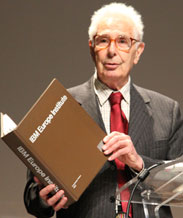
*A profound sadness overwhelmed everyone who had known Jean-Pierre Kahane when his death, which occurred last June 21 at the age of 90, was announced. His endearing personality and his gaze, sparkling with intelligence, made an impression from the very first meeting.
The son of a biochemist of Romanian origin, Jean-Pierre Kahane entered the École normale supérieure in 1946, then came first in the agrégation (the French competitive teaching examination) in mathematics three years later; he joined the CNRS immediately afterward. He defended his thesis under the supervision of Szolem Mandelbrojt in 1954 and became a senior lecturer at the University of Montpellier. He became a professor in 1957 and was appointed to Paris-Sud in Orsay in 1961, a university he presided over from 1975 to 1978. He was elected to the Académie des sciences in 1999. His research concerned harmonic analysis, mainly Fourier series and Fourier transforms.
Jean-Pierre Kahane cannot be understood without mentioning his commitment to education and to social justice. The first took the form of actions within the Société mathématique de France (which he chaired from 1971 to 1974) and at the head of the International Commission on Mathematical Instruction (ICMI). He lived out the second through his membership in the French Communist Party, which he maintained until the end. Yves Meyer, winner of the 2017 Abel Prize, testifies: "Jean-Pierre Kahane is one of the most original minds I know."
-
Jean-Pierre Kahane: "The mathematical forest has reclaimed its own"
--------------------------------------------------------------------
"Mathematical analysis, as S. Mandelbrojt practiced it, had little to do with what a famous author of the time [the collective of mathematicians known as Nicolas Bourbaki] called 'the fundamental structures of analysis'. 'Real' analysis, 'complex' analysis, infinitely differentiable functions, trigonometric series, Taylor series, Dirichlet series, and approximation theory were all inextricably intertwined there. For the first time, with S. Mandelbrojt, I had the sense of a virgin forest, with its tangled problems, its exuberant jumble of ideas and methods, its lush richness, and also the difficulty of entering it. In fact, over more than thirty years, I have constantly discovered new marvels in what is called classical analysis — that is, the analysis that Hadamard and Lebesgue knew, or could have known.
For the strangest thing about this virgin forest is that it is not virgin at all; it is the interwoven work of a hundred gardeners. From time to time, a team of gardeners tries to bring a little order to it; this sketches out new perspectives and introduces new points of view. In 1950, as it happens, the trend seemed to be toward French-style ordering. Bourbaki had laid out grand avenues; the park had just been opened to the public, and it was so beautiful that some could believe this setting to be fixed for eternity. […] I was under this great influence when S. Mandelbrojt revealed to me his corner of the forest, with its history and its hidden nooks. Since then, the mathematical forest has reclaimed its own, and we now know that it takes thousands of workers, permanently, to maintain and develop it. […]
In the mathematical forest, I have sometimes cleared certain passages or shortened certain paths. However, my tastes and my abilities have drawn me toward rare plants and strange shapes more than toward majestic rows. Were I to justify myself, it would suffice to recall that, among the mathematical objects most commonly used today, many were, in their time, irrational, imaginary, singular, exotic… Strange curves and twisted sets may perhaps follow the same path, if it is true that before germinating in our minds they existed in nature. And is there not some reason to think that this is indeed the case?"
-
Jean-Pierre Kahane, Notices sur les titres et travaux scientifiques de Jean-Pierre Kahane, 1981.
------------------------------------------------------------------------------------------------
-
Tributes
-----------
"He came regularly to the Espace Tangente"
"Countless tributes reached the Tangente editorial team spontaneously, highlighting the universally admired personality of Jean-Pierre Kahane. By the purest chance, our paths crossed often, going back to the days when, as a young student at the École normale supérieure, I attended his analysis courses at the University of Orsay, where he asked a small group of motivated students, myself among them, to write up the lecture notes that would be distributed to everyone. Forty-five years later, the relationship continued. Living not far from the Espace Tangente, he would come regularly to talk with members of the editorial team and to look closely at our publications."
Gilles Cohen, Editor-in-chief of Tangente
-
"Exceptional in many ways"
----------------------------------
"Jean-Pierre Kahane was exceptional in many ways, and I held him in profound admiration. […] Our paths crossed often, first on the scientific committee of the IREM (Institutes for Research on the Teaching of Mathematics), then at the CREM (Commission for Reflection on the Teaching of Mathematics), at the CFEM (French Commission for the Teaching of Mathematics), and, most recently, on the scientific committee of Math.en.Jeans. […]
I had interviewed him in 2007. He was fascinating. I watched that interview again last year, when I was asked to recall his work in the service of education […]. He hadn't aged a bit*. Yes, he will remain in our memories as someone whose commitment, in the many forms it took, was exceptional."
Michèle Artigue, researcher in mathematics education
* Find this interview online.
**
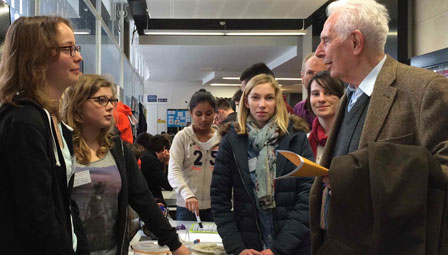
**
Jean-Pierre Kahane
at the congress
Math.en.Jeans 2016.
-
"In the service of mathematics education"
--------------------------------------------------
"It was with great sadness and emotion that we learned of the death of Jean-Pierre Kahane. Numerous testimonies reached the CFEM, paying tribute to his exceptional scientific output, his commitment to society, his taste for outreach, his remarkable intelligence, and the liveliness he displayed until his final days. On behalf of the CFEM, of which he was honorary president and where he represented the Académie des sciences, it is his equally exceptional commitment to mathematics education that I would like to highlight. The afternoon devoted to education during the conference organized last year in Orsay on the occasion of his 90th anniversary was an opportunity to recall it: his decisive role as president of the ICMI from 1983 to 1989, his constant support for the IREM network, whose scientific committee he chaired from 1997 to 1999, and his masterful presidency of the CREM, whose reports have become reference texts…"
Edwige Godlewski, president of the CFEM
-
"Counting rhymes echo tales"
--------------------------------------
"When in 2002, imagining that Jean-Pierre Kahane, starting from his grand idea of 'mathematics laboratories' in middle school and high school, might be interested in an educational experiment in primary school 'founded on language and meaning,' I asked him for a few words of preface to accompany the report, I had the great joy of seeing him accept quite simply. And the rare joy, further into the text, of reading this in his own hand: ' Counts for young and old, that is barely a play on words. To count and to recount are the same verb, contar in Spanish and Portuguese. In German, Zahl is the word for number, and erzälhen means to recount. In every civilization, counting rhymes echo tales.'
Does this not prove that one can be great, even very great, and yet not have 'forgotten' that a body of knowledge 'begins,' gently but rigorously, with the very young?"
Stella Baruk, author of innovative works on mathematics pedagogy, member of the editorial board of Tangente
The Société mathématique de France has also posted online a selection of tributes and articles by Jean-Pierre Kahane.