Established in 2002 to mark the bicentenary of the brilliant Norwegian mathematician Niels Henrik Abel (1802–1829), the Abel Prize recognizes a lifetime of achievement and is thus comparable to the Nobel Prize.
László Lovász, a Hungarian mathematician born in 1948, is one of the leading mathematicians of our time. His work in combinatorics—particularly graph theory—and algorithm design has long been influential; he is also a leading expert in complexity theory.
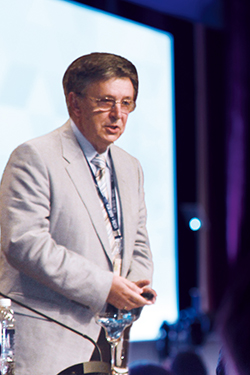
László Lovász.
Avi Widgerson, the other recipient, is an Israeli mathematician born in 1956 who has spent almost his entire career in the United States. Although he has worked in fields similar to Lovász's, he has approached them from a probabilistic perspective. He previously received the Nevanlinna Prize in 1994 for his research on the complexity of algorithms. Derandomization is one of his specialties—but what exactly is it? Some algorithms make random choices at certain stages. He constructed expander graphs, deterministic structures that limit the role of randomness (see Tangente 190, 2019).