They are almost unknown, "collaborators" working in the shadow of a husband, a father or a son. The Marquis Guillaume de l'Hôpital (1661–1704), author among other works of L'Analyse des infiniment petits pour l'intelligence des lignes courbes, married Marie-Charlotte de Romilley de la Chesnelaye in 1688. In standard biographies she is mentioned as a mathematician, nothing more — which, at the time, meant everything and nothing. One may suspect that she was her husband's close collaborator. Indeed, it was she who published his posthumous works, and she remained close to the mathematical discussions surrounding them until her death in 1737.
Rights slowly won
------------------
A little later, in the 19th century, the Scotswoman Mary Somerville (1780–1872) had to wait for her first husband's death before gaining the freedom to take up the study of mathematics. Supported by her second husband, she became a celebrity of the scientific world, beginning in 1831 with an English translation of Simon Laplace's La Mécanique céleste, to which she added numerous remarks and mathematical explanations. She pointed out, however, that her mathematical work could only be done once her duties as lady of the house and society woman had been fulfilled. Her scientific life continued until her death, while she also kept fighting for women's rights. She was, moreover, one of Ada Lovelace's teachers — Lovelace died too young, following her promising work with Charles Babbage.
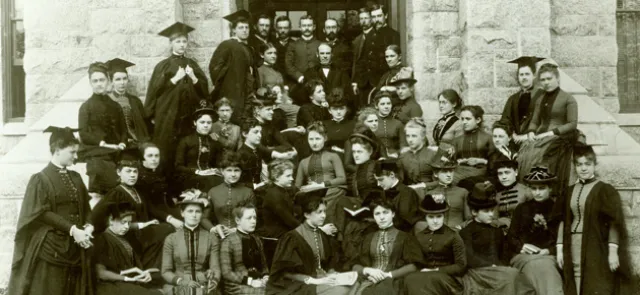
In the 20th century, women (very) slowly won a few new rights. From then on, truly great women mathematicians proved that they, too, could pursue very long and rich careers. The British mathematician Mary Lucy Cartwright (1900–1998) was a brilliant student; she passed the Oxford examinations with success — at least the portion open to girls. She had to wait until 1930 to earn her doctorate, at which point she showed exceptional research ability. During the Second World War, she worked with the mathematician John Littlewood on the problem of radio signals that seemed inconsistent with the models — a question vital to operations in the field. The two of them then discovered numerous phenomena that would become the first elements of chaos theory. In 1947 she became the first woman elected a Fellow of the Royal Society of England. She continued her work, receiving numerous medals. In 1969 she became Dame Mary Cartwright. She would go on, almost until her death, taking part in conferences in England, the United States, Poland…