American mathematician Karen Uhlenbeck, professor emerita at the University of Texas at Austin, is the first woman to receive the Abel Prize, honored for her pioneering work in geometry, analysis, and mathematical physics—a lifetime’s work! She is also deeply committed to promoting women in mathematics. May they follow her example.
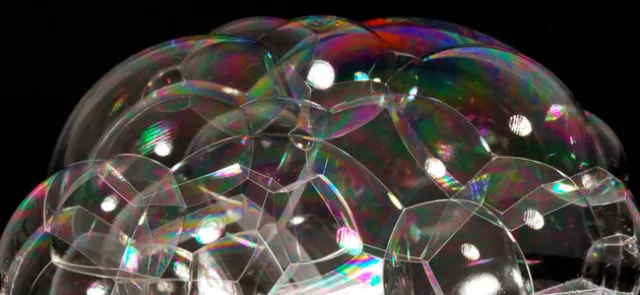
The laureate's theories, says the chair of the Abel Committee, have "revolutionized our understanding of minimal surfaces". Finding such surfaces means finding a configuration with minimal energy. That is what Karen Uhlenbeck and Jonathan Sachs did in the 1970s, "gradually deforming" a surface to see whether its energy could be minimized, even in cases where there was no certainty that the minimum could be reached. In these difficult cases, after rescaling, "bubbles" appear at finitely many points. Their work made it possible to study these singularities; the tools they developed are also used in Riemannian geometry (the Yamabe problem: given a Riemannian metric g, find a metric g’ with constant scalar curvature and conformal to g) and in the study of pseudoholomorphic curves introduced by Mikhaïl Gromov in 1986. Like the elementary particles of the quantum world, these "bubbles" further strengthen the connections between physics and mathematics.