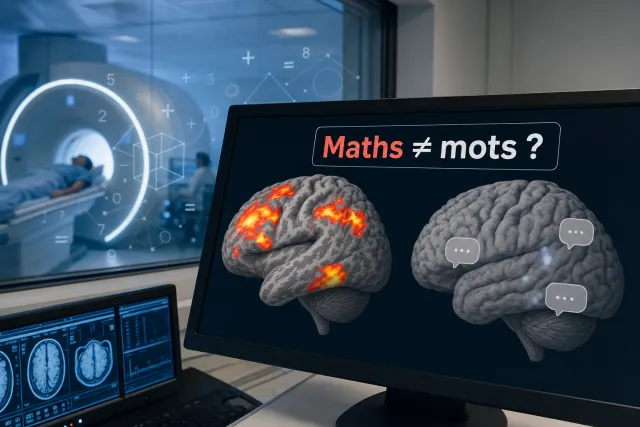
The links between the structure of mathematics and that of our brains seem to be increasingly confirmed as research is carried out by various teams around the world. In this field, France can boast one of the best-equipped laboratories: NeuroSpin, a brain neuroimaging center using high-field nuclear magnetic resonance (Commissariat à l'énergie atomique et aux énergies alternatives and Université Paris-Saclay).
We all have a mathematical brain!
-----------------------------------
At NeuroSpin, results were not long in coming: Stanislas Dehaene (born in 1965) and Marie Amalric (born in 1975) recently established that there is a complete separation in our brains between the cerebral processing of mathematical observations and that of non-mathematical activities (see our feature "Abstraction in Mathematics" in Tangente 207, 2022). What is surprising according to these researchers is the finding that "acquired activities, known as cultural activities, all call on extremely reproducible brain circuits. Always the same ones, from one person to another. What allows us to adapt to all kinds of teaching is not at all a very great cerebral flexibility, an immense cerebral plasticity; on the contrary, it is something extremely canalized, windows of plasticity within circuits that are, moreover, well organized". We therefore all seem to have a mathematical brain, more or less identical. And this brain appears to be pre-existing.
But what is meant by cerebral plasticity, and how does it change with age? According to biologist Daphné Bavelier (born in 1966), it is "the brain's capacity to reorganize itself when learning new tasks or developing during childhood. These are all the mechanisms enabling the establishment of new neural networks, which change according to environment or education". Still according to the cognitive neuroscience specialist, "in young children, there is very great malleability of neural networks: synapses can develop very quickly, connect, there is no barrier. As development proceeds, neurons become surrounded by a supporting matrix, then by myelin, structures that all act as brakes on plasticity. Children's neural networks are very malleable; then, over time, their capacity to reorganize is slowed". According to Professor Dehaene, puberty also seems to play a particular role in the closing of cerebral plasticity, and bilingual children appear to have better control abilities than others.
The capacity to learn, and thus to develop new neural networks, therefore declines structurally with age, which will surprise no one. Each of us can (alas) observe this over time… But there are ways to fight the inevitable! Thus, still according to Dehaene, "exposing a child to an enriched environment will make the period of plasticity last longer. Conversely, an environment of fear closes plasticity. […] Creating a school of fear (like the orphanages of Romania) risks closing plasticity for children who will find it much harder to learn". Another finding, according to Daphné Bavelier, is that video games (and especially the most violent among them) appear to have a… positive effect on maintaining plasticity. The importance of games, and mathematical games in particular, was also observed by Elizabeth Spelke (born in 1949), a researcher in Harvard's psychology department, during a large series of experiments on young children.