The dictionaries are not mistaken: even though definitions of the term "abstraction" differ across the Robert, the Larousse, and the Hachette, they all refer to the same concept of "bringing out the general properties of a category of objects, as opposed to the particularities of some of them." One fact thus seems to emerge: this could well be a mental process, even though none of the dictionaries consulted explicitly refers to the brain.
And yet. A child who has seen ten different cats will recognize the eleventh and identify it as a cat, even though it may be neither the same size, nor the same color, nor exactly the same shape as any of the previous ones. It is hard to imagine that this process of identification, of abstracting the notion "cat", is not the result of the brain's work. We can thus identify the brain as the engine of abstraction, developing our ability to grasp and conceptualize similarities and differences, all of which leads to the symbolic representation of concepts. This ability is not unique to human beings. The Japanese researcher Tetsuro Matsuzawa (born in 1950), a professor at Kyoto University, has spent years studying chimpanzees in the Republic of Guinea in their natural habitat (see Mathématiques et Biologie, Bibliothèque Tangente 42, 2011). These close cousins of ours are faced with more than six hundred plant species, of which they eat roughly a third. For each species, only certain parts are eaten (fruits, leaves, young stems, shoots or bark), which must be recognized, even though every tree, every plant, differs from the next. Building mental images, that is, abstractions, is therefore absolutely essential to their survival. We might then define abstraction as the result of an operation that selects one or more elements from a whole in order to consider them in themselves, whereas the concrete refers to reality taken as a whole.
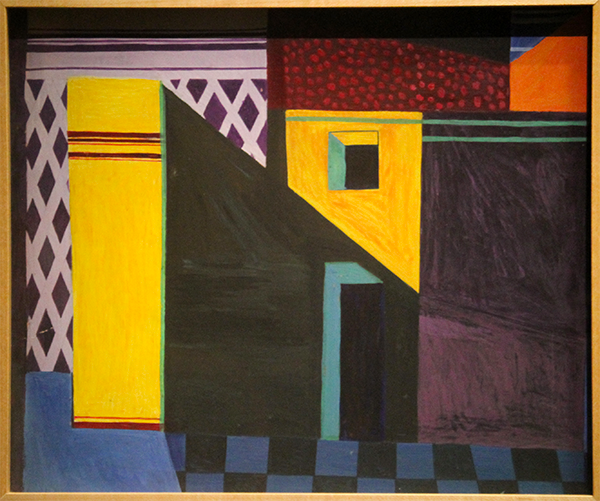
Abstract drawing. Ettore Sottsass, 1938.
Is this work "abstract" or "concrete" to you? What do you see in it?