Defining a category requires specifying a collection of objects and, for each pair of objects, a set of morphisms from the first object to the second. For example, consider the collection of sets: if E and F are two sets, the set Mor(E, F) can be the set of maps from E to F; E is then the domain of an element f of Mor(E, F), and F its codomain. We often write f : E → F to express that f is a map from E to F. When F = E, Mor(E, E) has a particular element: the identity map, denoted IE. Finally, if E, F and G are three sets and we consider f : E → F and g : F → G, two maps such that the codomain of the first is contained in the domain of the second, we then define g o f : E → G, the composite of f and g. This operation o, when defined, is associative. The category thus defined is often denoted Set.
Quite clearly, the notion of the category of sets belongs to a higher level of abstraction than that of a set, as considered by Georg Cantor at the end of the 19th century. It was introduced by the American mathematicians Samuel Eilenberg and Saunders Mac Lane in the 1940s, in the course of research on group theory and algebraic topology.
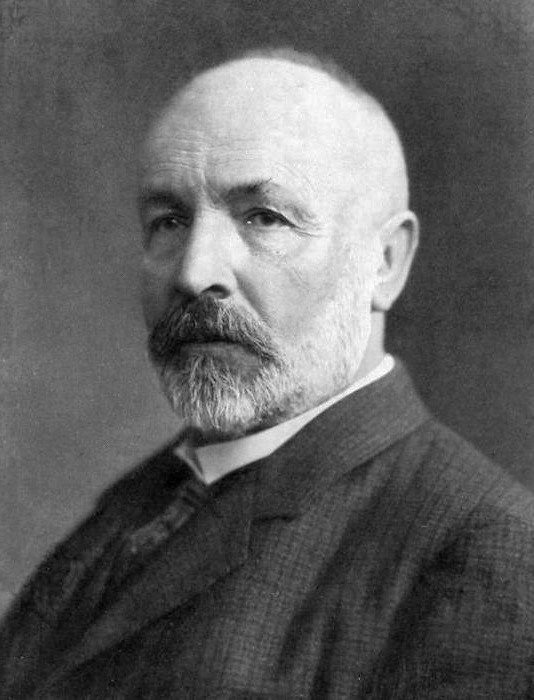
Georg Ferdinand Ludwig Philipp Cantor (1845–1918).