Until the early 21st century, three subjects were favored in algebra treatises for students: substitutions, the number of values taken by a function of several variables when these variables are permuted, and the numerical solution of algebraic equations.
In 1846, Évariste Galois's Œuvres mathématiques are published in the Journal de Liouville. Joseph Liouville, a recognized mathematician, promises to write a commentary on the work of the young mathematician who died in 1832 (see our special issue 82 Sur les traces d'Évariste Galois, 2022). It will never be written, or at least never published.
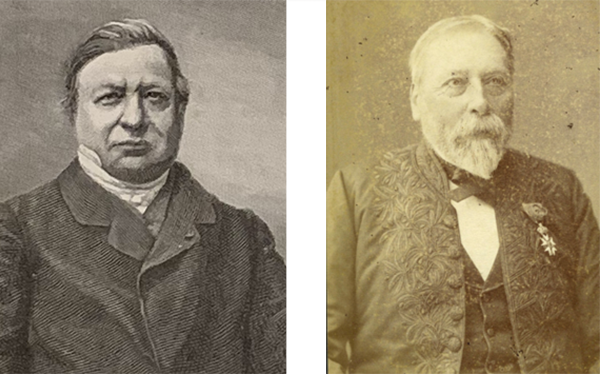
The first great treatise on higher algebra is written by Joseph Serret in 1849; it is a clear and complete account of "concrete" algebra, aimed at mathematics students at a level equivalent to a bachelor's degree. The treatise is reissued in 1854 and then in 1866, and Galois theory occupies an ever-larger place, but the approach remains traditional.