



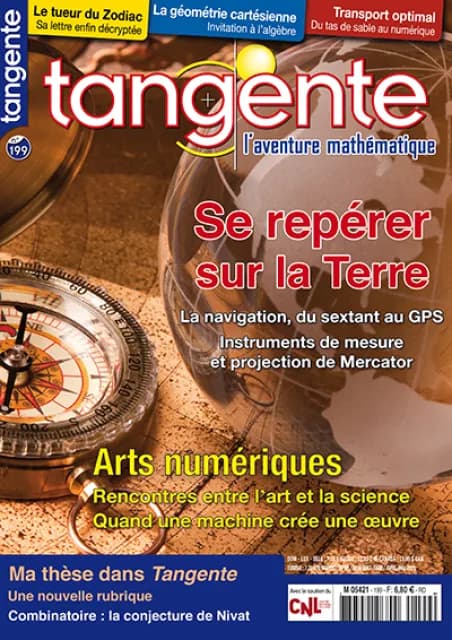
Finding your way on Earth
This issue is not fully translated into English yet; only translated content is shown.
Read the French versionAll folders in this issue

Finding your way on Earth
Knowing how to find your position and move around, on Earth as on the oceans, has been a vital necessity for centuries, for economic as well as political or military reasons. From the Jacob's staff, then the sextant, to GPS, inventiveness was boundless in imagining methods to achieve this by relying, most often, on mathematics. One thinks of the use of geometry and trigonometry, but not only that. To create his maps, Mercator, more than a century before the advent of integral calculus and logarithms, designed a transformation of the terrestrial sphere to the plane while preserving angles.
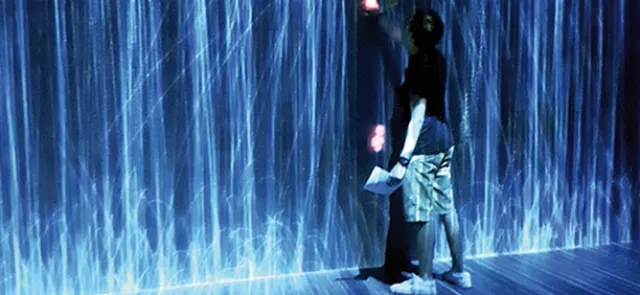
Digital Arts
Born with the development of computer science, digital art has enabled artists, by appropriating algorithms and programming languages, to explore new fields and to "dialogue" with their audience through abstract creations. Initially exploiting the use of repetitive patterns, this new art has opened, as technological opportunities arose, to fruitful and unexpected collaborations. Mathematics, omnipresent, once again shows that it can contribute to harmony. Iterative processes, simulation of randomness, exploration of numbers and combinations, use of analysis in music, artists play with these concepts. This confluence is also an opportunity to question the very notion of creation. Is writing a computer program part of it? And what about the increasingly numerous works generated by artificial intelligence?
All articles in this issue
The Zodiac's encrypted messages
At the turn of the 1970s, a serial killer was at large in California. What set him apart was that he communicated with the police through seventeen letters, four of them encrypted. The first was deciphered in 1969; the second has only just been cracked. These cryptograms put a new spin on classic cryptographic methods.
Nivat's conjecture
Although easy to state, questions in discrete mathematics are generally hard to solve. Progress often comes when a problem is linked to another field. This is the case with Nivat's conjecture, which has resisted mathematicians for more than twenty years.
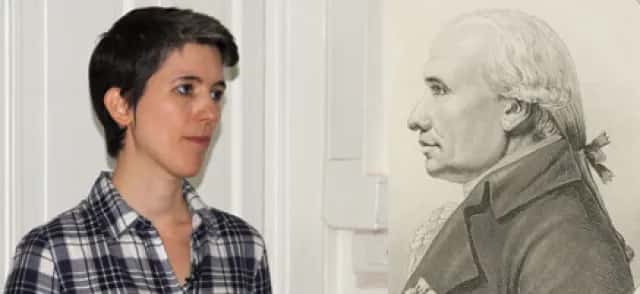
Two and a half centuries of optimal transport
Moving a pile of sand, transferring colors from one image to another, minimizing a group’s travel time—all these problems can be tackled using optimal transport. Gaspard Monge pioneered a theory that computing has made remarkably effective.
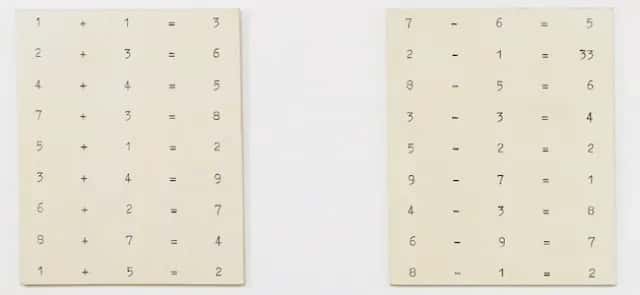
The artist and the number
Mathematics in general, and numbers in particular, have inspired many artists, including Dalí and Picabia. Some are drawn to the magic of numbers. Others find beauty in number sequences, which they bring to life in graphic art or painting.
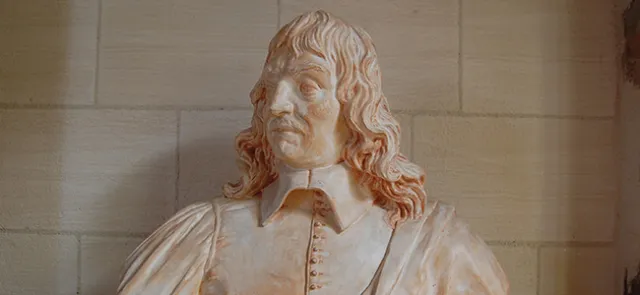
The emergence of Cartesian geometry
Greek geometers were the model for mathematicians when Descartes revolutionized geometry by introducing coordinates, making it possible to approach geometry through algebraic methods. Cartesian geometry was born.
László Lovász and Avi Widgerson, 2021 Abel Prize winners
This year, the Norwegian Academy of Science and Letters has put theoretical computer science and graph theory in the spotlight.
Alan Turing honored on the new £50 note
On June 23, 2021, Alan Turing (1912–1954) would have turned 109. To mark this symbolic date, the Bank of England will issue a new £50 note (about 58 euros) bearing the scientist's portrait.
Roman numerals and modern passions... to the point of absurdity
Controversy in Lutetia, in March MMXXI. The Carnavalet Museum, devoted to the history of Paris, has allegedly "abolished Roman numerals" from its new visitor experience on the pretext that they represent "an obstacle to understanding", claims the Italian daily Corriere della Serra.
Portraits of women mathematicians
To honor Maryam Mirzakhani, International Day of Women in Mathematics is observed on May 12, her birthday.
“Let’s bite into maths”: Culture and Mathematical Games Fair
Get a first glimpse of the programme for the 22nd Culture and Mathematical Games Fair. Held online, it will be accessible to everyone, from anywhere.
Enter the Tangente Prize for best article
The 2021 Tangente Best Article Prize is now open! Why not put pen to paper?