



Finding your way on Earth
Knowing how to find your position and move around, on Earth as on the oceans, has been a vital necessity for centuries, for economic as well as political or military reasons. From the Jacob's staff, then the sextant, to GPS, inventiveness was boundless in imagining methods to achieve this by relying, most often, on mathematics. One thinks of the use of geometry and trigonometry, but not only that. To create his maps, Mercator, more than a century before the advent of integral calculus and logarithms, designed a transformation of the terrestrial sphere to the plane while preserving angles.
All articles in this folder
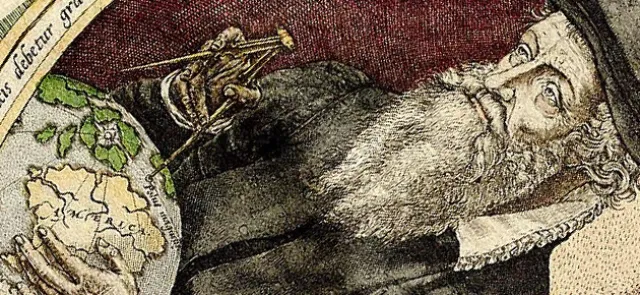
The Mercator projection
The best-known maps are based on the famous Mercator projection, named after its Flemish creator, who worked in the early Renaissance. Yet this projection relies on mathematical concepts developed well after the scholar’s death! So how could he have constructed his world map?
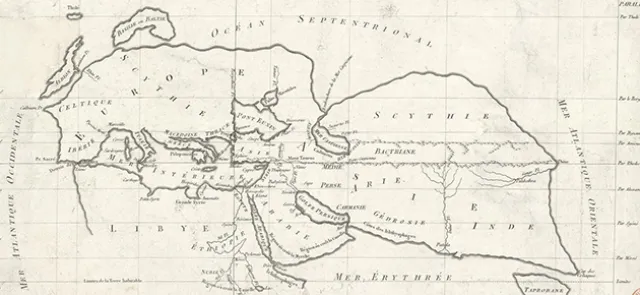
How not to lose your bearings
Since antiquity, navigators have sought to find their position at sea, first developing instruments and then maps before the practice was standardized in the 19th century. This practical and strategic use of mathematics endured for centuries before other tools superseded it.
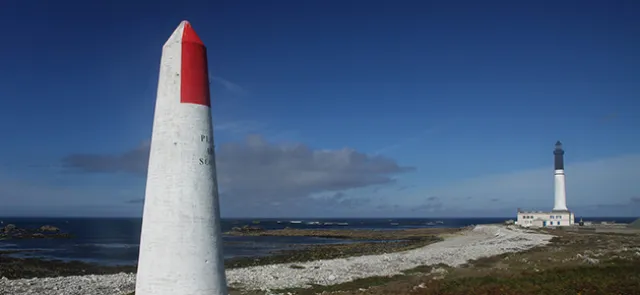
Finding your position at sea
How can you determine your position when sailing offshore or along the coast? With land in sight, one or two landmarks are enough. On the open sea, sailors’ ingenuity led to the invention of sophisticated instruments such as the sextant and the Cras plotter. A little geometry is essential to use them.

Mapping with Khartis: visualization | Tangente
Most data visualizations in the press are created with this open-source software, developed since 1995 by the mapping workshop at the Institut d'études politiques de Paris ("Sciences Po").

Math tourism: mathematics, geography and travel | Tangente
For some fifteen years, the "math tourist" website (mathouriste.eu) has been sharing photographs from Alain Juhel's mathematical travels and visits to places connected with mathematics and mathematicians.

Math City Map: Math trails | Tangente
If, by chance, you ever find yourself confined to within 10 km of your home, you can always turn the restriction to your advantage by creating mathematical challenges in your local area.