Le motif cubiste : problème de géométrie plane | Tangente
Le motif cubiste : un problème de géométrie plane
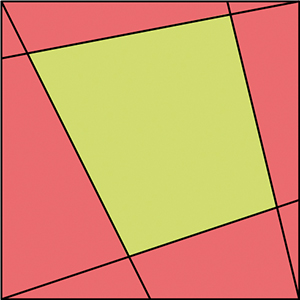
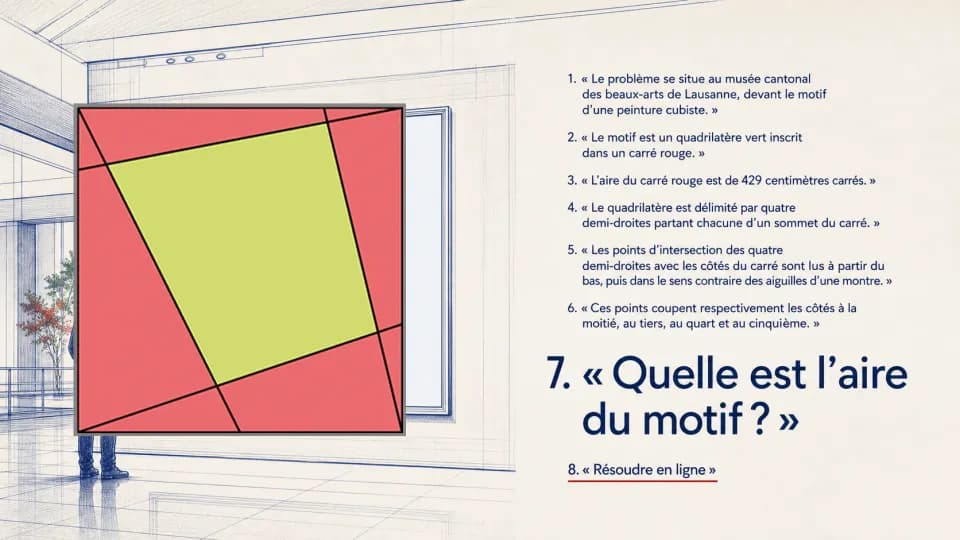
Déterminer l'aire d'un quadrilatère vert inscrit dans un carré rouge de 429 cm², délimité par quatre demi-droites issues des sommets.


This article is not yet available in English; the French version is shown.
Déterminer l'aire d'un quadrilatère vert inscrit dans un carré rouge de 429 cm², délimité par quatre demi-droites issues des sommets.


Articles recommended for you.

Besides their undeniable aesthetic appeal, mosaics and other archaeological remains from our past often hold wonderful mathematical surprises. These geometric examples from Gallo-Roman sites offer ample proof.

In a 1733 paper, the Comte de Buffon introduced what is now known as "Buffon's needle problem." This experiment illustrates a field of mathematics that is flourishing today: stochastic geometry, with its many applications ranging from telecommunications to medical imaging.

Leonardo da Vinci was not strictly speaking a mathematician, but the subject interested him, as it did many educated men of the Renaissance. We owe him an elegant proof of the Pythagorean theorem.

Several centuries before the Renaissance, whether building a church or a fortress, builders needed only a compass and an unmarked straightedge to draw arcs, pointed arches, basket-handle arches and rose windows. Let us explore the basic geometry behind their methods.